
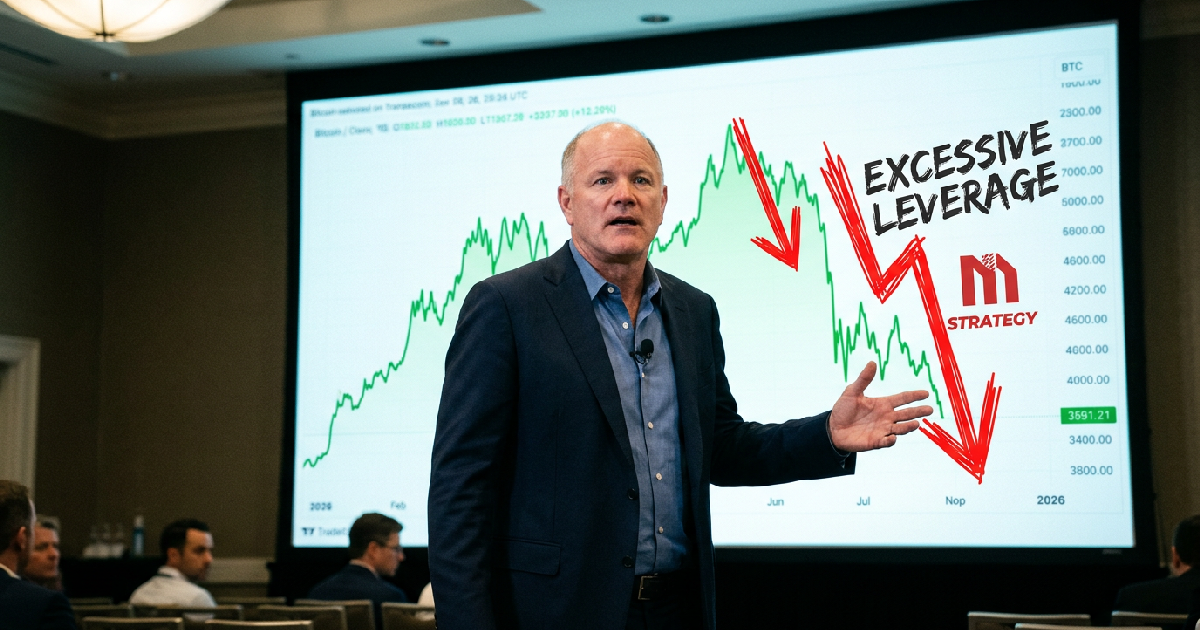

CEO Mike Novogratz of Galaxy Digital has identified excessive leverage as a primary catalyst behind the sharp cryptocurrency market correction witnessed throughout June 2026. Speaking on the latest market trends, the veteran investor noted that a buildup in derivatives positioning effectively turned standard volatility into a punishing drawdown, as a leveraged-long liquidation cascade intensified downward pressure across the digital asset ecosystem.
The June 2026 correction saw Bitcoin struggle to maintain technical floors, at one point losing significant value from its previous highs. Mike Novogratz emphasized that the fragility of the current price action is exacerbated by institutional outflows and specific structural concerns surrounding MicroStrategy (now referred to as Strategy).
How Mike Novogratz sees leverage impacting crypto
The firm, led by Executive Chairman Michael Saylor, has become a focal point for market anxiety following a “MicroStrategy-led breakdown in confidence” that Novogratz believes is impacting the wider investor landscape.
The core of the recent price instability lies in the derivatives market, where Mike Novogratz argues that trader positioning became dangerously overextended. When spot market weakness emerged, the presence of high leverage forced liquidations that amplified the descent. Novogratz explained that these leverage unwinds turn what might be ordinary market fluctuations into sharper, more painful corrections by triggering a self-reinforcing loop of selling.
This volatility is often tied to macro warning signs and rising treasury yields that sour the appetite for high-risk assets. Novogratz also cited a stronger U.S. dollar as a major headwind, stating simply that a “strong dollar is weak Bitcoin.”
With hawkish central bank signals impacting sentiment, the market has become highly sensitive to derivatives positioning, which can quickly turn against traders during periods of thin liquidity.
Strategy funding model faces investor scrutiny
Beyond leverage, Mike Novogratz highlighted growing concerns around the funding model used by Strategy for its Bitcoin acquisitions. The firm’s “flywheel” model—issuing equity at a premium to raise capital and repurchase Bitcoin—has come under pressure as its stock traded below the value of its BTC holdings.
Novogratz noted that investor confidence was further shaken by Strategy’s first Bitcoin sale since 2022, a move involving 32 Bitcoin that shattered the long-held belief that the company would never liquidate its assets.
Novogratz characterized Michael Saylor’s recent $2.5 million Bitcoin sale as a mistake, suggesting the firm should have issued stock to cover dividend obligations instead of touching its holdings. Strategy currently faces approximately $14 billion in unrealized losses, and its annual dividend obligations have reportedly reached $1.2 billion.
While the sale of 32 Bitcoin was small relative to its total stack, the psychological impact contributed to the broader rejection at key resistance levels across the crypto market.
Key details
Monitoring the technical health of the market, Mike Novogratz pointed to the $59,000 to $60,000 zone as “stunningly important” for Bitcoin’s immediate outlook. He warned that if these psychological support lines fail to hold, the market structure could deteriorate further, potentially opening a path toward the $45,000 level.
The CEO described the current environment as a “50/50” gamble between a quick recovery and a deeper drop, citing a complicated macroeconomic setup.
Institutional behavior has confirmed this pivot toward caution. Data indicates record institutional outflows from Bitcoin ETFs, with U.S. spot Bitcoin ETFs recording over $3 billion in net outflows across ten consecutive trading days.
BlackRock’s IBIT was among the funds seeing significant activity as cumulative market exits reached as high as $4.2 billion over an 11-day period. Investors are now closely watching Bitcoin exchange supply trends to determine if the market has truly reached a floor.
Macroeconomic headwinds and the search for stability
The broader economic environment has provided little relief for digital assets this month. Mike Novogratz pointed to the U.S. consumer price index (CPI) for May, which came in at a “hot” 4.2%, effectively crushing hopes for immediate interest rate cuts. Such inflationary data typically pushes investors toward safer havens, pulling liquidity out of the crypto ecosystem and strengthening the U.S. dollar against riskier assets.
For the remainder of the summer, Novogratz expects traders to focus less on speculative narratives and more on verifiable data points, including wallet activity and official technical updates.
While the market digests the consequences of excessive leverage, Novogratz also touched on the broader capital markets, noting the SpaceX IPO as a major event raising roughly $75 billion. For the crypto sector, however, clearing the current “leverage hangover” remains the priority before sustainable growth can return to the asset class.