
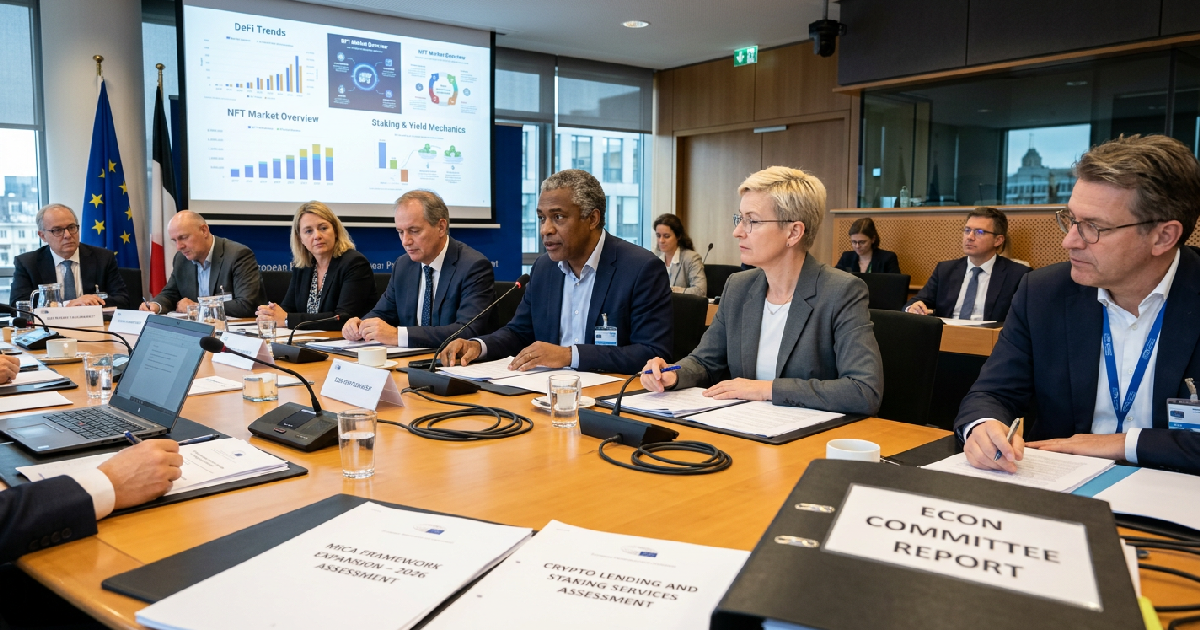

The European Parliament Committee on Economic and Monetary Affairs (ECON) urged the European Commission on June 27, 2026, to assess new regulations for decentralized finance (DeFi), staking, and non-fungible tokens (NFTs).
In a formal report released today, the committee detailed the need for a comprehensive evaluation of these sectors, alongside crypto lending services, to determine if further legislative action is required. This move signals a push to expand the reach of the European Union’s existing oversight beyond the current Markets in Crypto-Assets (MiCA) framework.
ECON committee targets DeFi and staking for assessment
Legislators are focusing on these specific niches to address perceived gaps in financial stability and investor protection that remain unaddressed by earlier rules. The recommendations represent a significant step toward a potential second phase of crypto-asset regulation within the Eurozone.
Lawmakers have set a tight timeline for the next stage of the process, with a plenary vote in the European Parliament expected on July 7, 2026.
The ECON report highlights the committee’s desire to bring “leaderless” systems into the regulatory fold. DeFi platforms, which operate via smart contracts without traditional intermediaries, present a unique challenge for enforcement. By urging the European Commission to study these protocols, lawmakers are seeking a way to apply compliance standards without effectively banning the underlying technology.
This focus comes as Ethereum recovery outlook remains a topic of interest for investors who utilize decentralized exchanges and staking protocols.
Key details
Staking services have also been singled out as an area requiring formal review. The committee is concerned that the absence of clear rules regarding yield generation and reward distribution could create imbalances in the market.
Since staking has become a primary method for token holders to earn returns, the ECON committee argues that a harmonized approach is necessary to prevent individual member states from creating a patchwork of conflicting local rules.
This push for centralized clarity mirrors efforts in other jurisdictions to move toward structured digital asset policies. For example, Russia lawmakers have pushed to legalize P2P trade for specific assets, showing a global trend toward replacing outright bans with complex regulatory registries.
For the EU, the goal is to ensure the European Commission has a clear mandate to draft rules that keep pace with technical shifts in blockchain finance.
Establishing rules for crypto lending and NFT markets
The report explicitly includes crypto lending services in its list of sectors needing urgent assessment. Following the high-profile failure of several lending platforms in recent years, the committee wants to investigate if strict capital requirements and collateral management rules should be mandated. The objective is to ensure that retail users are not left vulnerable during periods of extreme market volatility or platform insolvency.
Non-Fungible Tokens (NFTs) are also under scrutiny, despite having been largely excluded from original MiCA drafts. Lawmakers are now asking for an evaluation to distinguish between digital art and tokens that function as financial instruments.
If the European Commission determines that certain NFTs offer governance rights or financial returns, they could soon face the same rigorous disclosure rules as traditional securities. This regulatory creep into more speculative assets is happening as Bitcoin price analysis shows the market remains sensitive to policy shifts from major economic hubs.
The committee’s findings emphasize that the European Union must maintain a unified front to prevent “regulatory arbitrage.” If the European Commission follows these recommendations, it could lead to a broader legislative package that ensures all 27 member states adhere to the same standards for lending and digital collectibles. This would effectively close the door on companies seeking more lenient jurisdictions within the single market.
Key details
The publication of this report on June 27, 2026, is just the beginning of what is likely to be a lengthy legislative cycle. The immediate next step is for the full European Parliament to debate the findings and reach a consensus. This stage is crucial for establishing the political will required to move from an assessment phase into actual lawmaking.
And time is of the essence for lawmakers looking to finalize their stance. A plenary vote in the European Parliament expected on July 7, 2026, will likely determine how much pressure is placed on the European Commission to act.
If the report passes with a strong majority, the Commission will be forced to prioritize the drafting of a new regulatory framework that covers the “MiCA gaps” identified in the ECON report.
But the industry is watching closely. While the ECON committee insists these measures are for the benefit of market integrity, some developers worry that rigid rules could stifle the very innovation that made DeFi and NFTs attractive to the global market.
For now, the crypto sector in Europe faces a period of uncertainty as it waits to see if the European Commission will turn these recommendations into binding law.