
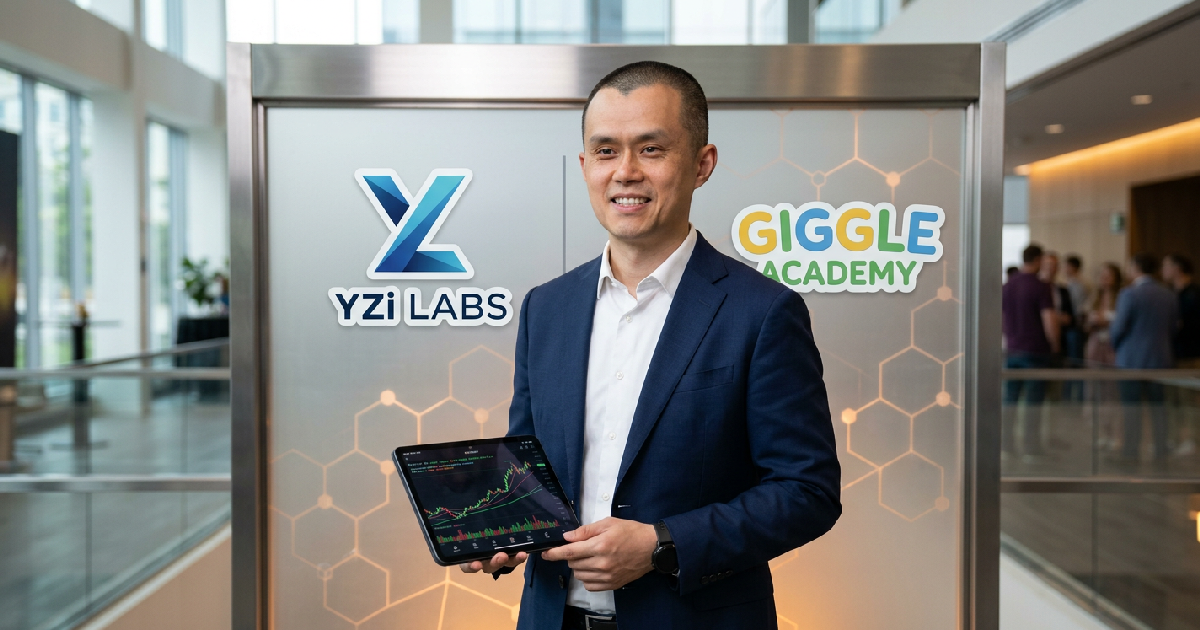

Binance founder Changpeng Zhao has completed a dramatic professional pivot toward venture capital and global education following his release from a United States federal prison. While he no longer holds the chief executive position at the world’s largest cryptocurrency exchange, the industry titan is exerting fresh influence over the market through his new investment vehicle, YZi Labs, and a non-profit initiative known as Giggle Academy.
The transition marks a significant chapter in the history of digital assets as the man universally known as “CZ” attempts to redefine his legacy. Despite the legal restrictions imposed by his settlement with the Department of Justice, Changpeng Zhao remains one of the wealthiest individuals in the world.
The rise of YZi Labs and the new altcoin investment framework
His strategic shift suggests that his ability to sway altcoin narratives and direct capital flows remains intact, even in a post-CEO capacity.
Industry observers have closely tracked the founder’s movements since his September 2024 release from a low-security facility in California. His recent appearance at the 2026 World Economic Forum in Davos signaled a return to the global stage. During his time in Switzerland, Zhao emphasized that his focus has moved away from day-to-day exchange operations and toward long-term innovation in the venture space.
The rebranding of Binance Labs to YZi Labs in January 2025 served as the first major signal of Changpeng Zhao’s new direction. This venture capital arm now operates with a mandate that transcends its previous affiliation with the exchange.
Key details
By positioning YZi Labs as an independent investment powerhouse, Zhao is able to mentor founders and provide seed checks without the direct regulatory baggage attached to Binance’s trading operations.
This pivot toward private equity allows Zhao to cultivate the next generation of decentralized infrastructure. His focus reportedly centers on projects that prioritize real-world utility over speculative trading. This shift in strategy is already impacting the broader market, as developers and entrepreneurs pitch their projects to his new syndicate in hopes of capturing the “CZ effect” that often precedes a surge in institutional interest.
The capital being deployed through YZi Labs is not merely about financial returns; it is about narrative control. As altcoin demand shifts toward new tokens with actual utility, Zhao’s endorsement of specific niches—such as decentralized AI or peer-to-peer education—often sets the trend for the entire sector. His influence now manifests through advisory roles and coordinated distribution with global market makers.
Educational outreach and the vision for Giggle Academy
Parallel to his venture capital efforts, Changpeng Zhao has dedicated a substantial portion of his time to Giggle Academy. This project aims to provide free, gamified basic education to children who lack access to traditional schooling.
While it appears to be a philanthropic departure from his crypto roots, the academy utilizes blockchain technology to manage credentials and incentivize learning, further embedding Zhao’s vision into the global digital fabric.
Analysts suggest that Giggle Academy serves a dual purpose. On one hand, it addresses a genuine humanitarian need for literacy and numeracy in developing regions. On the other, it provides a “cleaner” public image for a founder who spent much of the early 2020s in the crosshairs of global regulators.
By focusing on education, Zhao is building a legacy that is difficult for even his harshest critics to dismiss.
This move into the educational sector also has long-term implications for adoption. By introducing blockchain-based identification and reward systems to millions of young learners, he is essentially onboarding the next generation of users into a digital ecosystem. This soft-power approach may prove more durable than the aggressive market-share tactics he employed while leading Binance through its explosive growth years.
Key details
The path to Zhao’s current position was cleared by a series of legal and political developments that surprised many in the financial world. After stepping down as Binance CEO in November 2023 and serving his four-month sentence in 2024, Zhao was effectively sidelined from the American financial system.
However, the political climate shifted dramatically in late 2025, leading to a presidential pardon that restored much of his standing.
President Trump granted the pardon in October 2025, a move that many viewed as a signal of a more permissive regulatory environment for crypto pioneers. This legal absolution allowed Zhao to travel more freely and re-engage with high-level institutional partners. It also removed the “bad actor” label that had prevented some venture funds from co-investing with him during his period of house arrest and incarceration.
With his legal record effectively wiped clean in the United States, Zhao has been able to reclaim his role as a bridge between Western capital and Eastern innovation. His presence at Davos in January 2026 was a culmination of this rehabilitation.
The “pardon bounce” has also reflected in the markets, as investors viewed his return as a stabilizing force for the various ecosystems he helped found.
Market influence and the future of the Binance ecosystem
While Zhao no longer runs the daily operations at the exchange, his 90% shareholding in Binance means his financial interests remain tethered to the platform’s success. The exchange continues to navigate complex waters, recently seeing VanEck and Grayscale move toward spot BNB ETFs as institutional appetite for the ecosystem grows.
This transition from a founder-led startup to an institutionally backed infrastructure giant is largely happening under Zhao’s shadows.
Small-cap projects still view a “nod” from Zhao as the ultimate validation of their technology. Even a simple tweet or a photo with a project lead can send an altcoin’s market cap soaring. This reveals that the charisma of the founder often outweighs the official title of CEO.
Investors are betting on the man, his network, and his intuitive understanding of where the technology is heading next.
The current landscape is noticeably different from the “wild west” era of 2017. Zhao’s new approach is more calculated and focused on long-term sustainability. He has spoken frequently about wanting to fix the “misunderstandings” people have about him and his former company.
Key details
By pivoting to venture capital, he can foster innovation in a way that is less likely to trigger the ire of anti-money laundering authorities.
Second-order effects on altcoin liquidity and listings
The influence Zhao exerts through YZi Labs also impacts listing cycles on major exchanges. While Binance maintains a strict policy of independence regarding its listing committee, the market perceives a “YZI pipeline.” Projects that receive backing from Zhao’s new venture arm are viewed as have higher quality-assurance standards, which naturally makes them more attractive to liquid exchanges and retail traders alike.
This dynamic creates a cycle where Zhao’s capital essentially de-risks new tokens for the broader market. As speculative activity returns to the space, particularly as XRP and other legacy assets test resistance, the focus remains on where “new” money is flowing.
Zhao’s pivot ensures that he remains the primary architect of that flow, regardless of whether he holds the keys to the exchange’s main server.
As we move into the latter half of 2026, the question is no longer whether Changpeng Zhao can survive without Binance, but rather how Binance and the wider altcoin market will evolve under his renewed, albeit unofficial, guidance.
His journey from a jail cell to the stage at Davos is a testament to the resilience of crypto’s most famous founder and his enduring capacity to shape the industry’s future.