
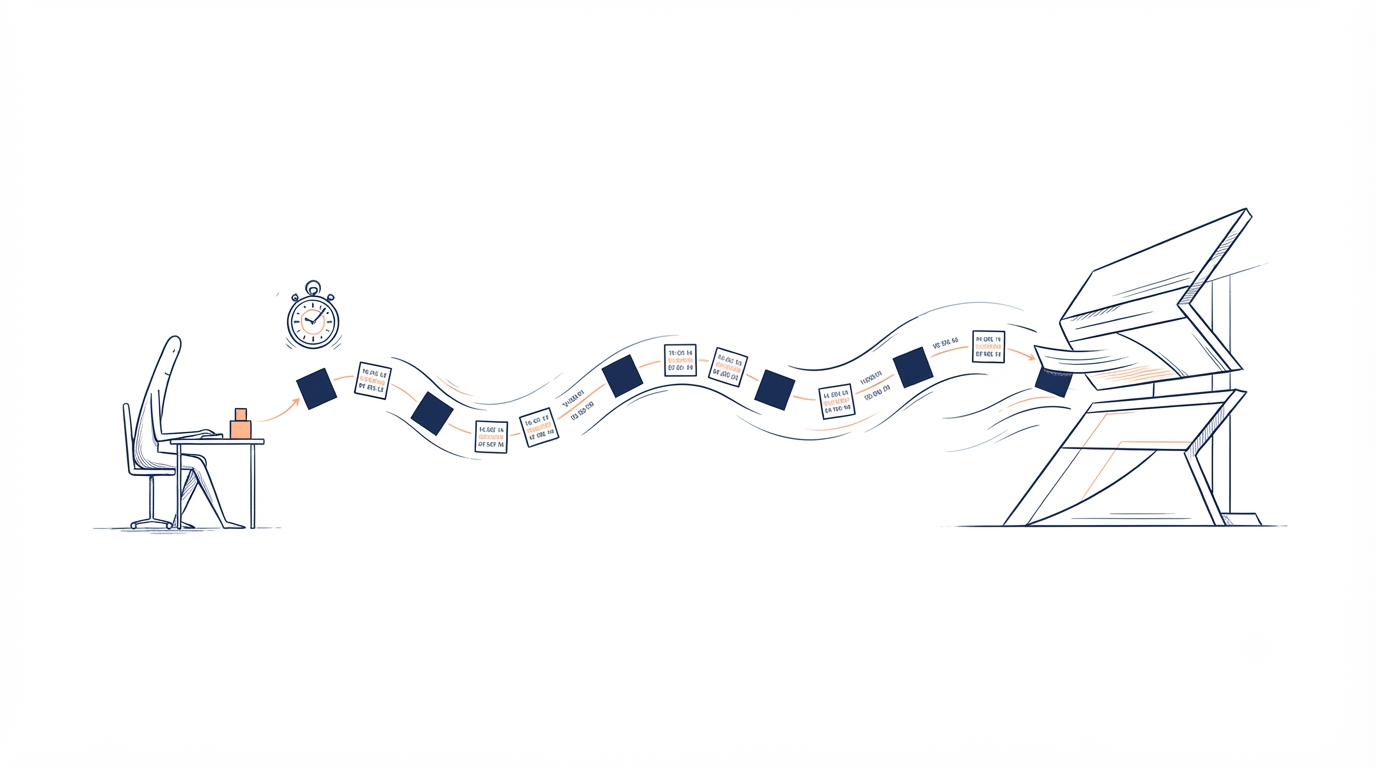

Have you ever tried to execute a simple trade on a decentralized exchange, only to watch the transaction spin endlessly while network fees eat into your capital? If you have spent any time in the digital asset space, you know that network congestion is one of the biggest hurdles to mainstream adoption. To understand why some networks bypass this bottleneck entirely, we need to look at the Solana Proof of History mechanism.
This innovation completely changes how a decentralized system perceives time. Instead of relying on raw computing power alone to force transactions through a crowded pipeline, the network introduces a verified internal clock. This seemingly simple shift in architecture is what allows the platform to handle massive user activity without slowing down to a crawl.
Understanding how blockchain works as the new global settlement layer
What You Need to Know Before Diving In
To truly appreciate this technology, we first have to understand a fundamental problem that has plagued decentralized networks for years: the dilemma of time. Every blockchain in existence has to perform three basic tasks. It must record transactions, verify that those transactions are legitimate, and organize them into a chronological order.
That last step—agreeing on the order of events—is surprisingly difficult. In traditional finance, systems do not have this problem. When you swipe a card or execute a trade on Nasdaq, a central server acts as the ultimate timekeeper. It stamps every action with a definitive time, and the system moves on.
In a decentralized blockchain, thousands of independent computers spread across the globe must agree on a shared reality without a central authority. They have to do this without trusting each other. Because network speeds vary and there is no official global clock, tiny differences in milliseconds can create major disputes about which transaction arrived first.
Imagine a global video call with tens of thousands of participants and no moderator. If multiple people try to speak at the same moment, the entire group has to pause, communicate back and forth, and vote on who actually spoke first. In a blockchain environment, this constant chatter between computers consumes immense resources and creates severe network latency.
Older networks require validators to exchange countless messages just to agree on the time and order of a single block. As the network grows and more users interact with the chain, this communication overhead becomes a massive traffic jam. This is exactly why early digital asset networks faced skyrocketing fees and crippling delays during periods of high demand.
Solana Proof of History: The Step-by-Step Mechanics
Many people mistakenly assume that the network’s speed comes from massive servers brute-forcing their way through data. The reality is much more elegant. Solana Proof of History is not a consensus mechanism; it is a cryptographic clock that proves time has passed between two events. Here is how it functions under the hood.
1. The SHA-256 Hashing Sequence
The system relies on something called a cryptographic hash function, specifically the widely used SHA-256 algorithm. Think of a hash as a unique digital fingerprint for a piece of data. If you take an entire encyclopedia and run it through a SHA-256 function, it will output a specific string of characters. If you change a single comma in that encyclopedia, the resulting fingerprint changes entirely.
The most important feature of this algorithm is that it is a one-way street. You can easily generate a hash from a piece of data, but it is mathematically impossible to look at the hash and reverse-engineer the original information. It is also entirely predictable, meaning the same input will always produce the exact same output.
2. Creating a Trustless Clock
Instead of just hashing data once, the network takes the output of a hash and immediately uses it as the input for the next hash, over and over again in a continuous loop. Because each step depends entirely on the completion of the previous step, this sequence cannot be faked or accelerated. You cannot calculate the 1,000th hash without calculating the 999 hashes that came before it.
Since modern computer processors take a predictable, measurable amount of time to execute these operations, this endless chain of hashes effectively becomes a verifiable digital clock. The network can look at the sequence and prove mathematically that a specific amount of time has passed between hash number 10 and hash number 50.
3. Organizing the Chaos
When you send a transaction—whether you are moving funds from an exchange like Kraken or interacting with a decentralized application—that transaction is injected into this continuous sequence. The transaction becomes permanently attached to a specific hash in the timeline.
Because the chronological order is already locked in by the math, validators do not need to pause and argue about what happened first. When a block of transactions is broadcast to the network, the receiving computers can instantly verify the timeline independently. They simply look at the cryptographic sequence and know the exact order of events.
This drastically reduces the communication required between computers. The network still needs to vote to finalize the block, but the heavy lifting of sorting the transactions is already done. The timeline is established before the consensus process even begins, allowing the system to process data with incredible efficiency.
Proof of History vs. Proof of Stake: Aren’t They the Same?
This is one of the most common points of confusion for investors and developers alike. Proof of History is frequently lumped together with consensus mechanisms, but they serve entirely distinct purposes. They are two separate pieces of technology working in tandem to keep the network secure and fast.
A consensus mechanism, like Proof of Stake (PoS), is the system that decides who gets to validate transactions and ensures everyone acts honestly. In a PoS system, participants lock up their capital as collateral. If they try to approve fraudulent transactions, their capital is slashed. It is an economic security model.
Proof of History, on the other hand, does not decide if a transaction is valid or if an account has sufficient funds. It simply organizes the data. It is a data structure, not a voting protocol.
If we use a real-world analogy, Proof of Stake is the board of directors voting on a company’s financial records. Proof of History is the time-stamping machine that organizes those records chronologically before the board even sits down at the table. By separating the task of timekeeping from the task of consensus, the network avoids the bottlenecks that choke other blockchains.
Is Solana’s Architecture Worth the Trade-Offs?
From an institutional and wealth management perspective, evaluating a blockchain requires looking beyond raw speed. We must assess the structural trade-offs. The architecture that enables this performance has drawn massive attention from the traditional finance sector, but it also sparks debate within the crypto-native community regarding decentralization.
Consider how traditional financial giants operate. High-frequency trading (HFT) firms on Wall Street spend hundreds of millions of dollars to lay fiber-optic cables in straight lines just to shave microseconds off their trade execution times. Systems like Nasdaq rely on atomic clocks to ensure absolute chronological precision.
The Solana Proof of History model is the closest the decentralized world has come to replicating this institutional-grade timekeeping. By reducing latency and enabling high-throughput processing, the network creates an environment suitable for global payments, complex decentralized finance (DeFi) protocols, and mass-market consumer applications. This is precisely why payment giants like Visa have explored the network for stablecoin settlements.
However, this performance is not free. The relentless speed of the cryptographic clock and the massive volume of data processed mean that running a validator on this network requires serious, enterprise-grade hardware. You cannot run a high-performing validator node on a standard consumer laptop. It requires substantial processing power, vast amounts of memory, and highly stable broadband connections.
This hardware requirement is the core of the centralization critique. In older, slower networks, almost anyone with a basic computer can participate in running a node, which maximizes global distribution and censorship resistance. By raising the barrier to entry for node operators, high-performance networks naturally limit the number of participants who can afford to help secure the base layer.
For institutional investors, this represents a calculated trade-off. Extreme decentralization offers unparalleled security but often results in a network too slow and expensive for retail adoption. The alternative is a pragmatically decentralized system that sacrifices some node distribution in exchange for the capacity to handle millions of daily users with transaction fees measured in fractions of a US dollar.
Ultimately, the market is proving that there is a massive demand for fast, cheap, and highly scalable infrastructure. While purists may debate the hardware demands, the practical utility of a network that feels as responsive as a traditional web application cannot be ignored. The architecture solves a real-world problem that has previously kept digital assets sidelined from daily commerce.
Conclusion
Understanding how the network operates beneath the surface is crucial for any serious participant in the digital asset space. The Solana Proof of History mechanism proves that scaling a blockchain is not just about forcing bigger blocks of data through the pipes; it is about fundamentally rethinking how distributed networks communicate and perceive time.
By introducing a cryptographic clock that organizes events before they are validated, the network dramatically reduces communication overhead. This leads to a smoother, faster, and cheaper experience for users, whether they are trading assets on a decentralized exchange, buying digital collectibles, or sending cross-border payments.
While the architecture demands robust hardware and invites valid discussions about long-term decentralization, its impact on the industry is undeniable. It has pushed the boundaries of what is possible in Web3, bridging the gap between the clunky user experiences of early crypto and the seamless interfaces we expect from modern technology.
AI crypto trading tools: how to upgrade your analysis without losing your mind (or your capital)
This content is for informational purposes only and does not constitute financial advice.