
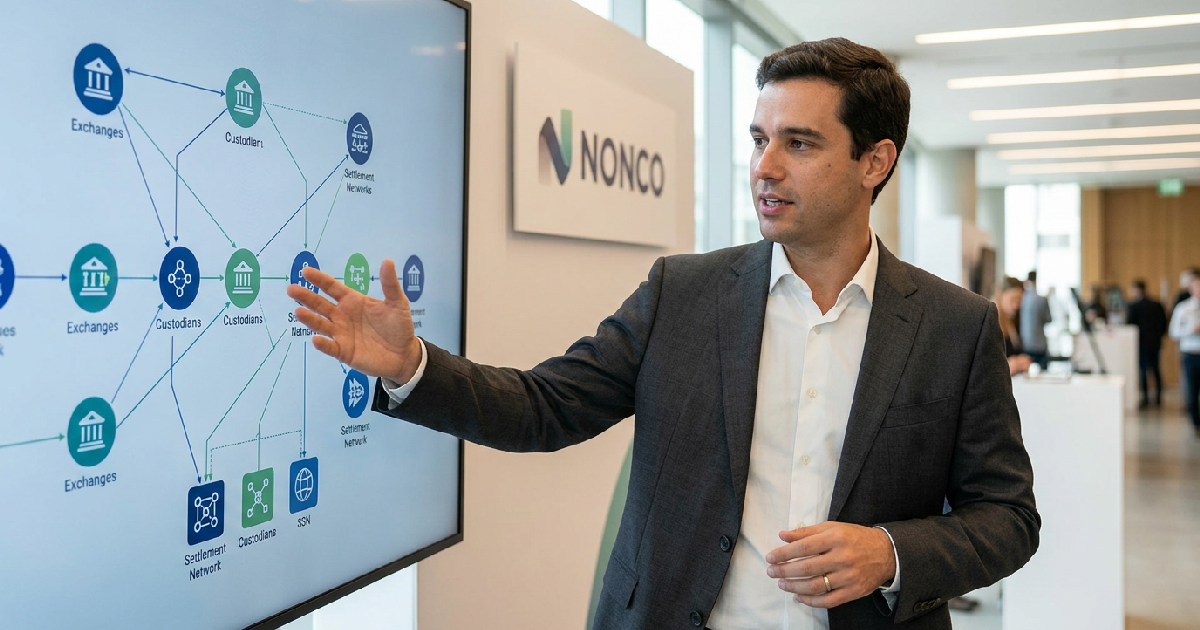

Caue Teixeira, Chief Technology Officer at Nonco, argues that digital asset infrastructure has become the “prevailing currency” of the industry as the market shifts focus toward the systems that enable trade rather than the assets themselves.
In a recent analysis, Teixeira noted that while debates over which cryptocurrency will lead the market continue, the primary winners are the exchanges, custodians, and settlement networks that operate 24/7. This transition marks a pivot from speculative asset creation to the establishment of a robust financial architecture that supports real-world economic functions.
Infrastructure resilience in volatile market conditions
The maturation of the sector is increasingly visible through its operational demands. Unlike traditional finance, the digital assets ecosystem was built to function without pause, requiring resilience and reliability to manage cross-border liquidity in real time.
This always-on environment has transformed infrastructure from simple connectivity into an “invisible framework” of governance, compliance specialists, and trusted relationships. As institutional adoption accelerates, the demand for sophisticated solutions with high transaction throughput and enhanced security has become a cornerstone of the market.
The stability of this underlying architecture is often tested during periods of market stress. Alen Pavlović of Liquibit Capital recently used liquidation feeds to identify that forced selling in early June peaked near the $68,000 level for Bitcoin.
Key details
This peak occurred days before the asset actually reached its bottom, illustrating how infrastructure such as liquidation monitors and market-making venues provide critical data for professional investors. Such technical frameworks are essential for maintaining confidence when Bitcoin tests major resistance levels or experiences sudden price swings.
Infrastructure today encompasses a wide range of specialized services beyond blockchain technology itself.
This list includes:
- Regulated exchanges and liquidity venues
- Third-party custodians and security providers
- Compliance specialists and KYC infrastructure
- Global settlement networks and payment providers
- Data centers and fiber-optic networks
Driving forces behind the shift to infrastructure
Several macroeconomic and technological trends are fueling the demand for digital infrastructure. The rise of artificial intelligence (AI) has revolutionized the sector, as AI tools help manage assets more efficiently while simultaneously driving demand for data centers and telecommunication towers.
Furthermore, the tokenization of traditional assets—including real estate and financial instruments—is expected to reduce management costs and improve liquidity, provided the underlying infrastructure can support the increased volume. This shift is notable as major firms move toward spot ETFs, requiring tighter integration between decentralized protocols and traditional compliance standards.
Stablecoins have also emerged as a vital layer of “foundational scaffolding” for modern payments. By offering real-time settlement and lower transaction costs than legacy banking, they act as the plumbing for new value transfer systems. This evolution toward utility is reshaping how asset managers and pension plans view the space.
The industry is moving away from the era of pure speculation and toward a permanent fixture of the global economy, where the companies providing the custody, security, and connectivity capture the most durable value.
Key details
Even as investor sentiment shifts and exchange supply reaches lows, the necessity for robust infrastructure remains the constant factor in the market’s survival.
Regulatory clarity and institutional integration
The move toward infrastructure is supported by a growing sense of regulatory permanence. In the United States, policy proposals in 2024 began including specific language regarding the treatment of digital assets, signaling that they are no longer viewed as a peripheral trend.
Institutional investment is further aided by the development of trusted indexes, which make digital assets more investable for foundations and endowments. SEC Chairman Gary Gensler previously noted that certain stablecoins could be viewed as security-based swaps, a designation that would require firms to comply with rigorous regulatory regimes.
Ultimately, the digital asset landscape has entered a phase where the “picks and shovels” are more significant than the gold itself. Whether a specific coin or a Central Bank Digital Currency (CBDC) facilitates a transaction, the infrastructure ensuring that transaction is secure, compliant, and instantaneous is what remains essential.
As the market continues to evolve through 2026, the durability of these systems will define the boundaries of the new financial architecture.