
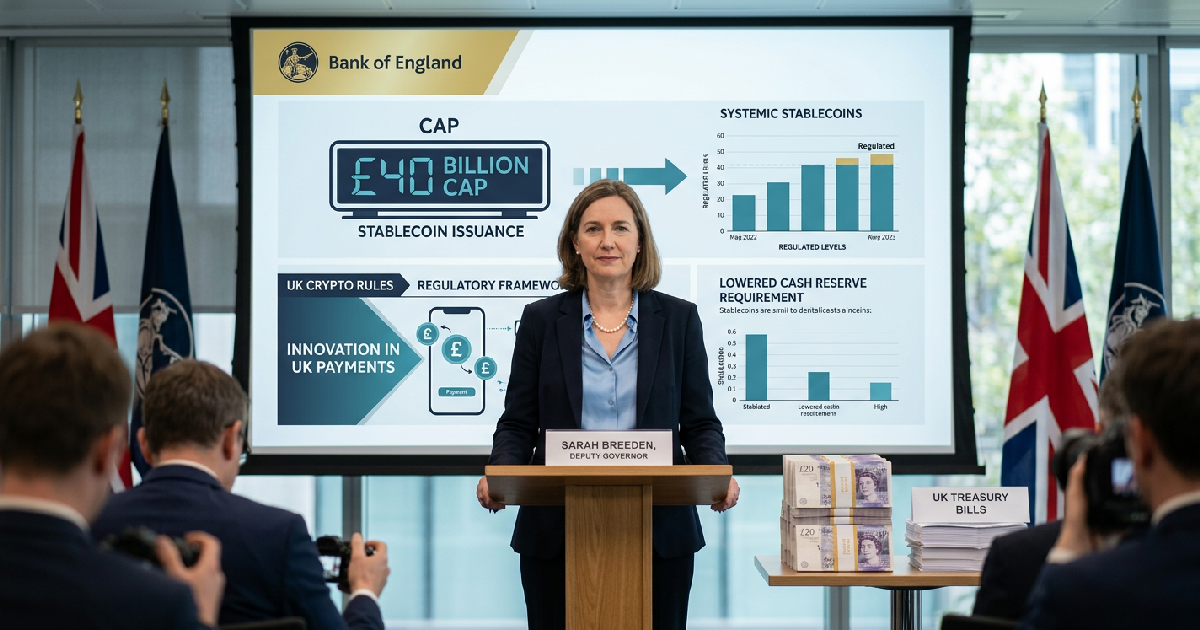

The Bank of England (BoE) has officially relaxed its proposed regulatory framework for sterling-denominated systemic stablecoins, replacing controversial individual and business holding caps with a temporary £40 billion “guardrail” per product. Published on Monday, June 22, 2026, the new policy statement and draft Code of Practice also lower the cash reserve requirement at the central bank to 30%, down from the previously proposed 40%.
Deputy Governor Sarah Breeden described the move as a foundations-setting moment for a “world leading regime” intended to foster innovation in UK payments. The revisions come after industry stakeholders raised concerns that earlier 2025 proposals—which suggested limiting individual holdings to £20,000—would restrict the viability of stablecoin business models and discourage growth within the British fintech sector.
Bank of England implements £40B stablecoin guardrail to support innovation
The new £40 billion guardrail serves as a temporary ceiling for the issuance of each systemic stablecoin product, designed to prevent a massive migration of deposits from traditional banks into digital assets. The BoE plans to review this guardrail regularly, with the goal of removing it once potential risks to credit provision are sufficiently addressed.
This replaces the previous plan to cap individual holdings at £20,000 and business holdings at £10 million.
In addition to the issuance limits, the central bank has adjusted its stance on reserve management. Systemic stablecoin issuers are now required to hold 30% of their backing assets as non-interest-bearing cash deposits at the central bank.
Sarah Breeden acknowledged that the previous 40% requirement may have been “overly conservative,” stating that the bank settled on the lower 30% figure after evaluating industry feedback. This shift occurs as Bitcoin price analysis and broader market trends continue to influence how regulators perceive the stability of digital assets.
The remaining 70% of reserves can be invested in short-term UK government debt. Specifically, the BoE permits these funds to be held in UK Treasury bills with maturities of up to six months. By allowing a larger portion of reserves to move into these short-term instruments, the regulator aims to balance financial stability with a more feasible operational model for private issuers.
Strict redemption standards and consumer protection and transparency
Despite the easing of holding limits, the Bank of England is maintaining rigorous safety protocols to ensure these assets function effectively as money. Issuers must ensure that stablecoins remain redeemable at face value within 24 hours. The BoE explicitly prohibits issuers from suspending redemptions, even during times of market stress, and has mandated that there be no minimum redemption amount to protect retail users.
Furthermore, issuers are required to keep backing assets in a statutory trust, ensuring they are ring-fenced from the company’s other liabilities. They must also maintain separate capital and liquidity within a trust to cover potential winding-down costs. These measures are designed to maintain trust in digital pounds, much like the institutional interest seen in other banking sectors regarding digital asset exposure.
While the BoE will ban the payment of interest on stablecoins themselves, the regulator noted it would allow credit card-style rewards for transactions. This distinction ensures the tokens are utilised primarily as a medium of exchange.
Katie Harries, Head of Policy in Europe at Coinbase, questioned how “temporary” the issuance caps would be, noting that the UK is currently the only country capping the issuance of stablecoins in its own currency.
Roadmap for UK systemic stablecoin operations into 2027
The publication of the draft Code of Practice marks the beginning of a final feedback phase. The Bank of England has confirmed that the consultation period for these draft rules will remain open until September 22, 2026.
The central bank intends to finish the work on the Code of Practice by the end of 2026, creating a clear path for regulated stablecoins to begin full operation in the United Kingdom starting in 2027.
This regime, which sits atop the Financial Services and Markets Act 2023, is focused specifically on systemic payment systems. Non-systemic stablecoins, such as those used primarily for trading other cryptoassets like Ondo Finance or other tokens, will remain under the primary supervision of the Financial Conduct Authority (FCA).
The BoE and FCA are working jointly to ensure the end-to-end regime aligns with the government’s 2024 National Payments Vision.
Ultimately, the pivot toward a guardrail system indicates a willingness by the BoE to adjust its trajectory based on industry concerns regarding profitability and innovation. By removing the hard individual limits and improving the reserve investment ratios, the central bank is attempting to build a foundation of trust for digital money while acknowledging the commercial realities of the emerging crypto sector.