
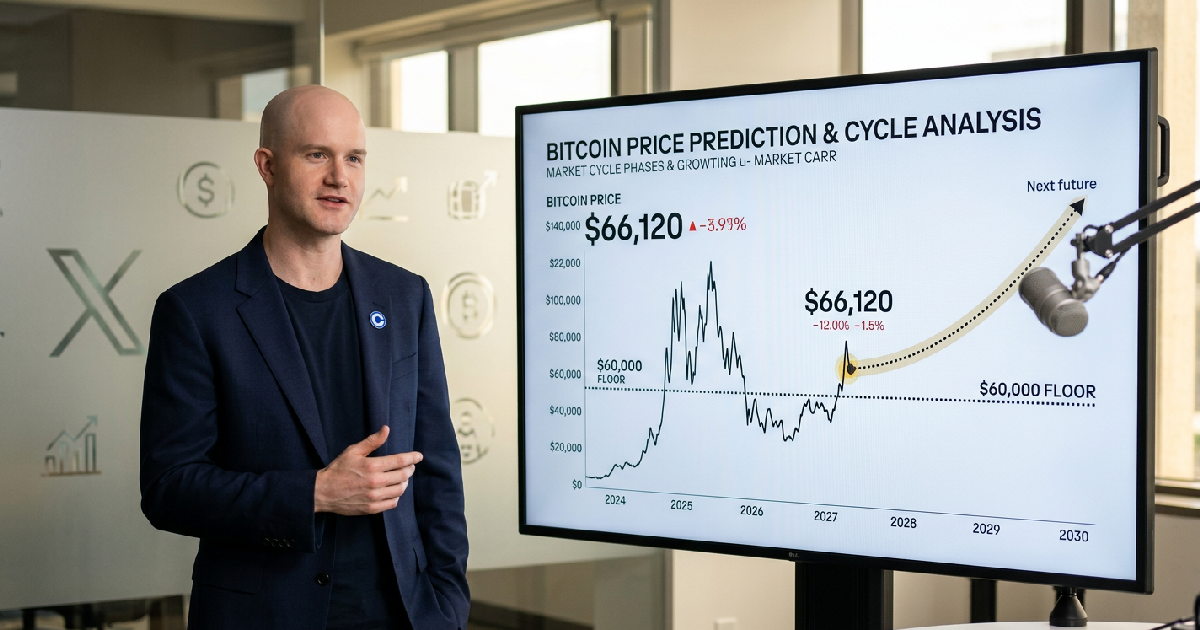

Coinbase Global Inc. (COIN) CEO Brian Armstrong stated on June 15, 2026, that his “instinct” suggests bitcoin may have bottomed around the $60,000 level.
Speaking in a video posted to X (formerly Twitter) and during an interview on the MoonShots podcast, Armstrong noted that while no one can pinpoint a market floor with certainty, $60,000 likely represents the base of the current cycle. The flagship cryptocurrency traded above $66,000 on Monday, rising approximately 3% over 24 hours.
The recent price action follows a turbulent period for digital assets. Bitcoin previously dipped to a low of approximately $59,743 on June 5, marking its weakest performance since late 2024. The token currently sits roughly 50% below its all-time high of nearly $126,000, which it achieved in October 2025.
Armstrong’s comments come as investors look for stability after months of bitcoin price shifts amid geopolitical developments and macroeconomic uncertainty.
Markets appeared to cheer reports on Monday regarding a potential breakthrough in the Middle East. News that the United States and Iran reached a deal to reopen the Strait of Hormuz coincided with the recovery in digital asset prices.
While some traders linked the two events, on-chain analysts remain cautious, noting that a price floor does not always trigger a sustained bull run without consistent demand.
Brian Armstrong uses four-year cycle to identify bitcoin floor
Armstrong pointed to the historical four-year halving cycle as a primary framework for his assessment. This cycle has historically alternated between aggressive bull markets and cooling bear phases since 2011. By suggesting $60,000 as a potential bottom, the CEO implies that the current drawdown is consistent with past market resets before a eventual recovery takes hold.
Despite the recent volatility, Armstrong reaffirmed his status as a committed long-term holder. “I’m as bullish as ever on Bitcoin, and still long (as always). It’s never as good or bad as it seems,” he posted on X. He continues to describe the asset as “the new digital gold,” reinforcing his belief in its role as a store of value.
The cryptocurrency’s price has fluctuated between $50,000 and $70,000 over the last several months. Armstrong argued that treating the BTC price as the sole thermometer for the Web3 industry is becoming outdated. He noted that bitcoin market structure analysis shows sectors like stablecoins, derivatives, and prediction markets are continuing to expand regardless of the spot price.
On-chain data challenges immediate recovery after bitcoin bottom
While Armstrong expressed optimism, data from analysis firm CryptoQuant suggests the path forward remains complex. Analysts there recently noted that although bitcoin entered a “value zone” near its realized price of roughly $53,600, demand conditions have remained negative. They warned that unstable ETF flows mean a confirmed recovery is not yet a certainty for the remainder of June.
Coinbase’s leader remains focused on a much longer horizon, looking toward the end of the decade. He expects prices to be significantly higher by 2030, a sentiment that aligns with earlier forecasts where he suggested a $1 million valuation was possible. This outlook relies on the continued maturation of the global crypto ecosystem and institutional adoption of blockchain technology.
The CEO also highlighted that broader market health is often masked by bitcoin’s price drawdowns. He cited the growth in perpetual contracts and decentralized finance as evidence of a maturing industry. For now, the market is watching macro catalysts and Federal Reserve policy closely to see if Armstrong’s $60,000 floor will hold against further selling pressure.
Bitcoin price targets and shifting market sentiment in 2026
The current recovery above $66,000 offers a reprieve for traders who have navigated a 50% drawdown from the 2025 peak. This consolidation phase is part of a larger trend where bitcoin signals indicate shifting market structures across the industry. Whether the recent bounce is a relief rally or the start of a trend reversal is the primary debate among institutional desks.
Armstrong’s “instinct” about the bottom reflects a broader confidence in the digital asset’s survival through multiple cycles. He noted that it will take some time for the success of newer crypto products to “sink in” for the average investor. Until then, the $60,000 mark remains a critical psychological and technical level for the entire market to defend.
As the industry moves away from using bitcoin’s price as its only indicator of success, more specialized assets are drawing attention. This includes stablecoins, which have recently seen their own set of risks and developments. The focus for many remains on whether institutional ETF flows will stabilize enough to provide the liquidity needed for bitcoin to retest its previous highs in the coming years.