
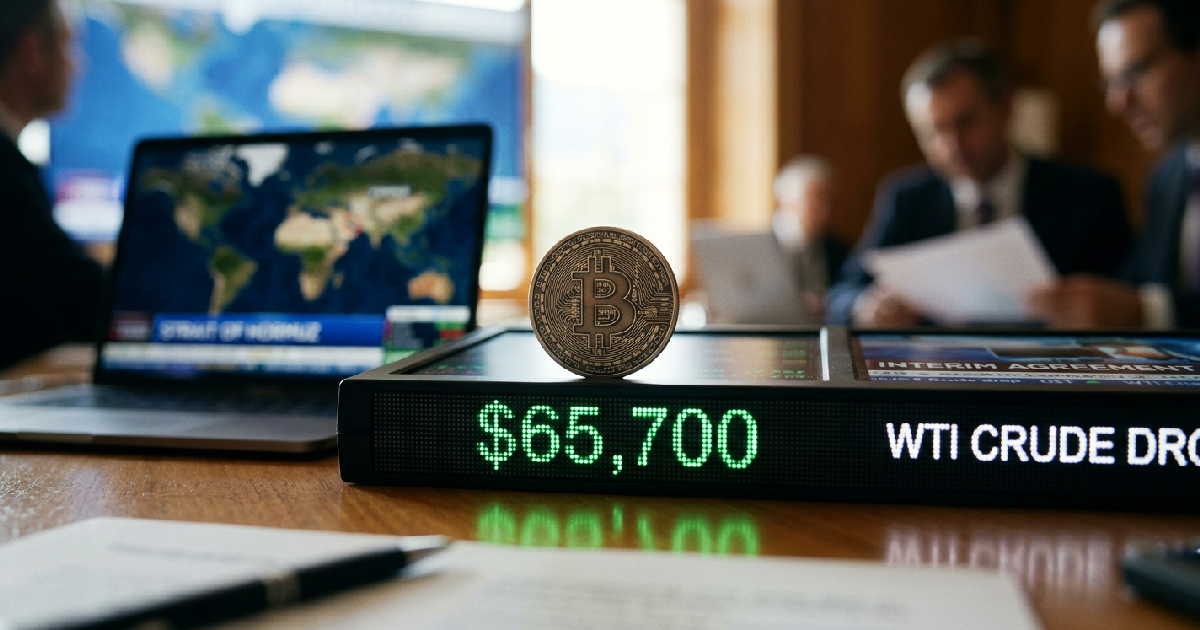

Bitcoin rose 2% over the last 24 hours to reach $65,700 following reports that the United States and Iran have reached an interim agreement to end hostilities and reopen the Strait of Hormuz.
The reported deal, which would be signed in Switzerland this Friday, spurred a rally across risk assets while sending energy prices into a steep decline. This price action marks Bitcoin’s highest valuation since a sharp market correction in early June.
The market reaction follows localized reports citing that official sources from both nations said they reached the milestone agreement. While a formal announcement from the White House or Tehran has not yet been issued, the prospect of de-escalation in the Middle East has immediately shifted investor sentiment.
The reopening of the Strait of Hormuz, a critical maritime chokepoint for global energy, remains the lynchpin of the reported terms.
This sudden pivot comes as investors were already closely monitoring technical indicators. Many market participants have noted that why Bitcoin traders care about the 200-day moving average is fundamental to understanding if this news-driven spike can be sustained. For now, the $65,700 level represents a significant recovery as the geopolitical “risk-off” premium attached to digital assets begins to dissolve.
Energy and equity markets react to reported peace deal
The impact of the potential diplomatic breakthrough was felt most acutely in the energy sector, where WTI crude oil plunged nearly 5%. Prices for the commodity dropped to just under $81 per barrel, representing its lowest level in roughly two months.
Traders are pricing in the end of supply-chain threats that have persisted while the Strait of Hormuz remained a point of military and political friction.
Traditional financial markets mirrored the crypto sector’s optimism. Nasdaq 100 futures climbed 1.5%, while S&P 500 futures rose 0.9% in the hours following the news. This broad-based rally suggests that investors are rotating capital out of defensive assets and back into growth-oriented sectors. The easing of inflationary pressures tied to oil prices appears to be providing a tailwind for both stocks and Bitcoin.
The reported agreement arrives at a time of shifting tectonic plates in the crypto landscape. Recently, Bitcoin price stabilizes near geopolitical shifts as the asset continues to serve as a real-time gauge for global stability. If the Friday signing in Switzerland proceeds as reported, it could provide the necessary foundation for a more durable upward trend in the final quarters of 2026.
Switzerland signing remains the next major milestone
While the interim agreement has provided an immediate boost, the formalization of the deal in Switzerland is the primary focus for the week ahead. Market analysts suggest that any deviation from the reported Friday timeline could spark renewed volatility.
The cryptocurrency market, in particular, has shown a high degree of sensitivity to the prospect of a stabilized Middle East and the resulting normalization of global trade routes.
The current rally helps the market move past the “plunge” noted in early June, which had dampened expectations for institutional inflows. Analysts are now looking at broader structural changes, noting that Bitcoin signals and market structure analysis are turning more favorable as global uncertainty recedes.
The ability of Bitcoin to maintain support above the $65,000 mark will be critical as the details of the peace deal are confirmed.
For now, the reopening of the Strait of Hormuz stands as the most tangible victory for global markets. By securing the transit of approximately one-fifth of the world’s daily oil consumption, the deal removes a significant “black swan” risk from the board.
Bitcoin investors are treating this de-escalation as a clear signal to re-engage with risk, betting that the path to Swiss diplomacy remains clear of further conflict.