
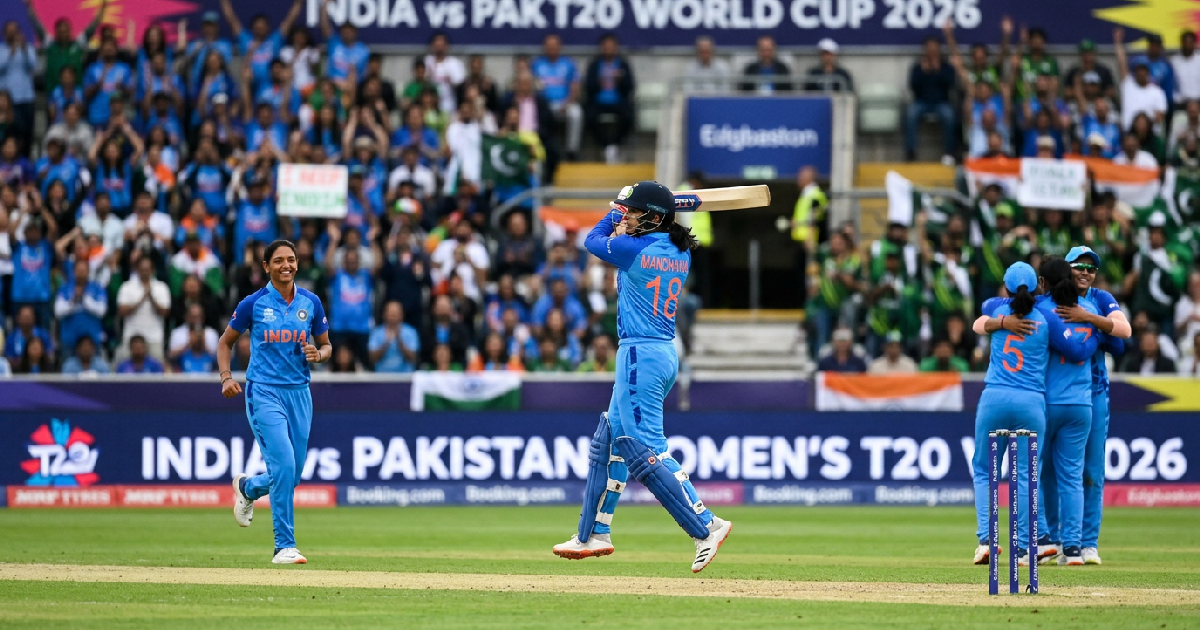

India Women secured a convincing 64-run victory over Pakistan Women on Sunday, June 14, 2026, at Edgbaston, Birmingham, to open their ICC Women’s T20 World Cup 2026 campaign. Smriti Mandhana led the charge with a blistering 68 runs while Deepti Sharma provided the clinical all-round stability to ensure India defended a total of 170/6 by bowling out their rivals for just 106 in 17 overs.
The high-stakes encounter at the historic Birmingham venue saw India flex their superior depth in both departments. Under the leadership of Captain Harmanpreet Kaur, the Indian side appeared composed before a packed crowd, effectively silencing the Pakistan chase early and securing two vital points in the group standings.
This win continues India’s strong run of form in international fixtures during a year where global sports interest is peaking.
Pakistan, captained by Fatima Sana, struggled to maintain the required run rate after losing wickets at regular intervals. Despite a fighting 41 from opener Muneeba Ali, the middle order collapsed under the pressure of a mounting required rate and disciplined Indian fielding. The result provides India with a significant net run rate boost as they look toward the later knockout stages of the tournament.
Smriti Mandhana and Richa Ghosh power India to formidable total
Choosing to bat first after winning the toss, India benefited from a masterclass in aggressive opening by Smriti Mandhana. The left-hander struck 68 runs off just 44 deliveries, reaching her half-century in 34 balls while punishing the Pakistani pace attack. Her innings featured nine boundaries and two sixes, providing the platform India needed after the early loss of Shafali Verma.
Captain Harmanpreet Kaur played a steadying role with 36 runs off 35 balls, ensuring the scoreboard kept ticking during the middle overs. However, the true momentum shift occurred when Richa Ghosh joined the fray. The young wicketkeeper-batter smashed 34 runs off 17 deliveries, a cameo that included a 23-run assault on a single over bowled by Tasmia Rubab.
While Fatima Sana and Sadia Iqbal managed to pick up two wickets apiece, the Pakistan bowling unit struggled to contain the Indian hitters during the death overs. Tasmia Rubab’s expensive figures highlighted the struggle to find a consistent length against India’s lower-order power.
By the time the innings closed at 170/6, the target already looked steep for a Pakistan lineup that has historically struggled with high-velocity chases.
Pakistan chase falters despite Muneeba Ali resistance
The Pakistan reply started with a stroke of luck as Muneeba Ali was dropped twice within the first four overs. She attempted to make the most of those lives, scoring 41 runs off 35 balls. However, the lack of support from the other end proved fatal.
Ayesha Zafar fell for 12, and Aliya Riaz could only manage 18 before being stifled by the Indian spin contingent.
The bowling of Deepti Sharma was particularly effective in the middle period, where she dried up the boundaries and forced errors through subtle variations in pace. Much like how MLB home run predictions often rely on identifying reliable power hitters, cricket matches of this magnitude are decided by the consistency of specialist spinners under pressure.
India’s fielding was largely sharp, barring the early lapses against Muneeba Ali. Once the breakthrough was made, the Pakistan lower order showed little resistance. The final five wickets fell for just 22 runs as the pressure of the 171-run target became insurmountable. India eventually bundled Pakistan out for 106 in the 17th over, completing a dominant tactical performance.
Impact of the victory on the T20 World Cup standings
This result places India at the top of their group early in the competition, a position crucial for avoiding the tournament favorites in the semi-final draw. The 64-run margin is a statement of intent to the rest of the field, showcasing an Indian team that is physically fit and tactically versatile.
The victory marks a successful start for the coaching staff who focused heavily on middle-over acceleration.
For Pakistan, the defeat highlights a need for greater batting depth and better execution in the final five overs of their bowling innings. Fatima Sana will need to regroup her squad quickly, as the short turnaround of the T20 World Cup format leaves little room for error.
The team’s inability to capitalize on India’s early fielding mistakes will likely be a point of contention in their post-match review.
As the tournament progresses, the focus shifts to how the top-tier teams manage shifting conditions in the United Kingdom. Just as market structure analysis helps traders understand long-term shifts, these early-round results provide the “market signals” for which teams are truly prepared for the pressure of a World Cup final. India’s performance at Edgbaston suggests they are among the primary contenders for the title.
Looking ahead to India’s upcoming fixtures
India’s next matches will test their ability to maintain this high-scoring intensity against more balanced bowling attacks. The form of Smriti Mandhana and the finishing ability of Richa Ghosh are early highlights, but the team will look for more consistency from the top three following Shafali Verma’s cheap dismissal and Jemimah Rodrigues’ early exit for just one run.
The bowling unit, led by the experience of Deepti Sharma and the leadership of Harmanpreet Kaur, appears ready for the challenges of various pitch types across the UK.
With the tournament still in its infancy, this 64-run victory serves as a perfect foundation for what Indian fans hope will be a historic run to the trophy. Pakistan, meanwhile, must find a way to spark their batting if they hope to remain in contention for the knockout rounds.