
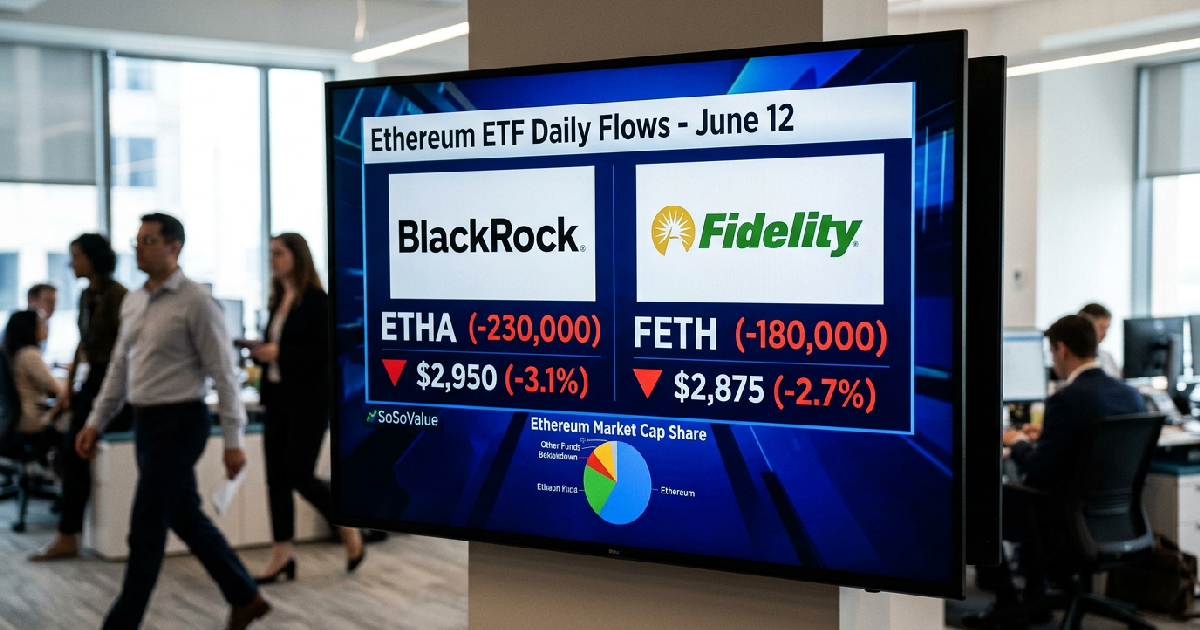

U.S. spot Ethereum ETFs recorded $4.95 million in daily net outflows on June 12, 2026, according to data from SoSoValue. This marks the fourth consecutive day of withdrawals for the sector, led specifically by outflows from BlackRock and Fidelity. While the broader market experienced cooling interest, most of the other nine listed funds reported zero flow changes for the session.
BlackRock’s iShares Ethereum Trust (ETHA) saw the most significant activity, with a daily net outflow of $4.53 million, representing 2,720 ETH leaving the fund. Fidelity’s FETH followed with the second-highest daily outflow of $415,230. These movements occurred as all listed Ethereum ETF prices declined, with ETHA dropping 1.02% to $12.57 and FETH falling 1.01% to $16.58.
The current losing streak follows a period of high demand earlier in the month, including $101.7 million in fresh capital during early June. Analysts suggest the shift reflects a wider “risk-off” sentiment as traders monitor market confidence and geopolitical shifts. This tactical positioning comes as federal regulators continue to review compliance standards for digital asset Countering the Financing of Terrorism (CFT) protocols.
BlackRock and Fidelity dominate trading despite withdrawals
Despite the recent daily exits, BlackRock’s iShares Ethereum Trust remains the heavyweight in the competitive landscape, holding $4.75 billion in net assets. This gives the fund a 2.36% share of the total Ethereum supply. On June 12, ETHA registered the highest daily volume among all listed funds, with 28.21 million shares traded and a total value reached of $355.36 million.
Fidelity’s FETH maintains a smaller but notable footprint with $799.31 million in net assets. The cumulative net inflow for the iShares product to date stands at $11.303 billion, while Fidelity’s fund has seen $2.117 billion in total life-to-date inflows. These figures indicate that while short-term pressure is evident, historical demand for the two leading funds remains high compared to smaller rivals.
Grayscale, which operates the second-largest fund by net assets, saw no daily net inflow or outflow on June 12. Its flagship ETH fund held $1.46 billion in assets and traded at a 0.15% fee. The stagnation across Grayscale’s ETHE and other products like Bitwise (ETHW) and VanEck (ETHV) suggests that recent selling pressure is highly concentrated in the industry’s most liquid retail vehicles.
Staked Ethereum products remain the lone outlier
One notable exception to the negative trend on June 12 was BlackRock’s ETHB, a staked Ethereum ETF. It was the only fund in the complex to post a net inflow, though the gain was a modest $20,000. This follows a more substantial $1.7 million inflow recorded on June 10, highlighting a niche but persistent interest in products that offer exposure to staking rewards.
The total net assets for all U.S. spot Ethereum ETFs now stand at $9.16 billion. This sector has grown to represent 4.56% of Ethereum’s total market capitalization in less than two years. Investors are currently weighing these figures against shifting market structures as they decide whether the current four-day outflow streak is a temporary consolidation or a longer-term cooling of the market.
Launched in the summer of 2024, the spot Ethereum ETF market has seen its fair share of volatility since inception. While BlackRock’s iShares Ethereum Trust (ETHA) was notably launched on June 24, 2024, the broader rollout of spot Ethereum ETFs in the U.S. occurred in July 2024.
In the period since those launches, the entire asset class has secured between $9 billion and $11 billion in cumulative net inflows.
Market outlook and institutional positioning
The daily total trading value for the Ethereum ETF complex reached $483.85 million during the most recent session. Institutional positioning appears increasingly tactical, with investors reacting to day-to-day price fluctuations rather than maintaining a purely bullish stance. This caution is reflected in the prices of every listed fund, which all ended the day in the red on June 12.
Regulatory transparency remains a factor for large treasury desks, particularly regarding new compliance audits. If the price of Ethereum fails to find support in the coming days, the streak of outflows could expand. For now, the focus remains on whether BlackRock’s ETHA can maintain its liquidity dominance as it navigates its multi-year integration with Coinbase Prime and its 0.25% expense ratio.