
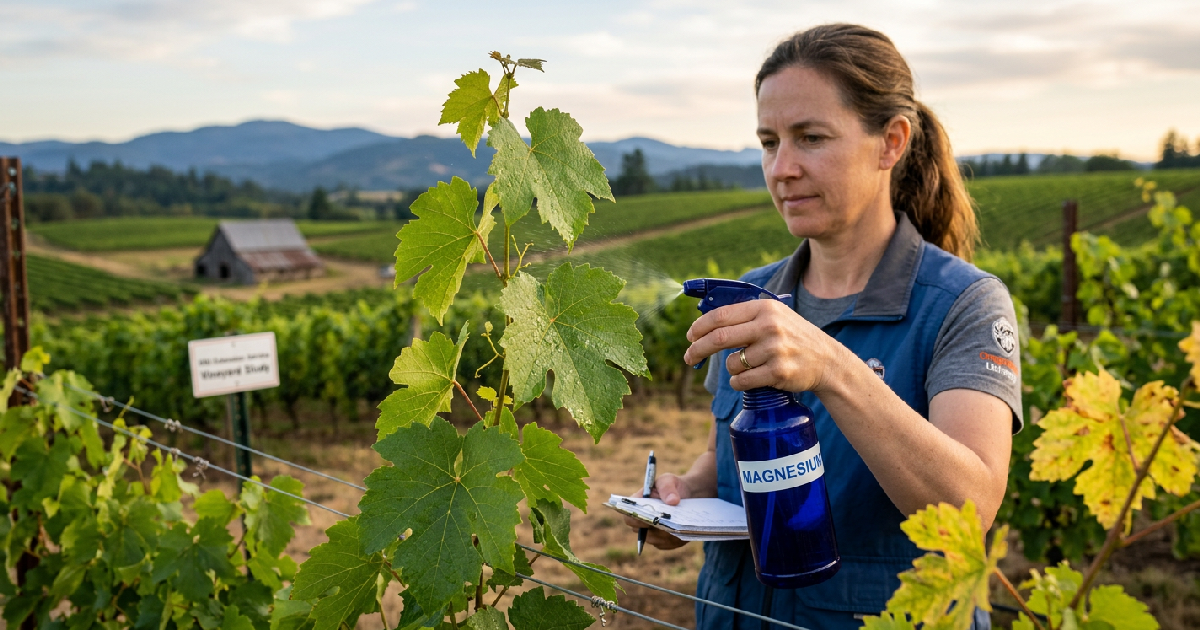

Researchers from Oregon State University (OSU) and the USDA Agricultural Research Service (USDA-ARS) have released findings from multi-year trials regarding magnesium decisions in Oregon vineyards. The studies, which focused on Pinot noir, Chardonnay, and Mourvèdre varieties, aimed to clarify the effectiveness of foliar fertilizers in correcting visible nutrient deficiencies. Led by Santosh Kalauni, R.
Paul Schreiner, and Patricia A. Skinkis, the research provides data-driven benchmarks to help growers avoid unnecessary or ineffective fertilization during the growing season.
The Willamette Valley study, conducted between 2021 and 2023, and the Milton-Freewater trial, which ran from 2023 to 2024, evaluated how vines respond to nitrogen, potassium, and magnesium. While visible symptoms like interveinal chlorosis were reduced by foliar sprays, the results showed that these visual improvements do not always correlate with better production.
In the Willamette Valley trial, foliar magnesium application did not consistently improve vine growth, yield, or fruit composition—specifically must brix, pH, and titratable acidity—over the three-year period.
Magnesium is vital as a central component of chlorophyll and activates more enzyme systems than any other plant nutrient. However, deficiency often manifests in mid- to late summer as yellowing or reddening on older leaves, creating a “Christmas-tree” pattern.
Because these visual cues can be misleading, the researchers sought to verify the recommended leaf magnesium threshold of 0.25% through the High-Resolution Vineyard Nutrition Project, noting that leaf nutrient analysis is far more accurate for management than visual diagnosis alone.
Impact of foliar magnesium on vine productivity
A major focus of the research was determining if foliar-applied magnesium sulfate (MS) or chelated magnesium (MC) could improve crop outcomes in magnesium-deficient vineyards. In the Milton-Freewater study, researchers found that magnesium sulfate significantly increased leaf magnesium levels and decreased the severity of deficiency symptoms compared to both the control groups and chelated versions.
This makes MS a lower-cost, effective solution for improving leaf health when the vine has poor magnesium uptake from the soil.
Despite the better leaf appearance, fruit yield components and chemistry were not significantly altered by these fertilizer treatments. This lack of a measurable boost in fruit quality suggests that growers must carefully weigh the cost of application against the purely aesthetic benefit of greener leaves. While com/why-bitcoin-traders-care-200-day-moving-average-analysis/”>analysts look at moving averages to judge market health, viticulturists are encouraged to use the 0.25% threshold to judge vine health before committing resources to spray programs.
The studies also highlighted that specific plant parts respond differently to nutrient supply. For instance, leaf blades showed a clear response to nitrogen, potassium, and magnesium applications. In contrast, petioles responded to nitrogen and potassium but remained unresponsive to magnesium sprays in the Willamette Valley trials. This distinction is critical for growers when deciding which tissues to send for laboratory analysis.
Environmental factors and magnesium decisions in Oregon
Several environmental and management factors can worsen magnesium deficiency in the field. Very acidic soil conditions, specifically those with a pH below 5.5 or even up to 6.2, are known to hinder magnesium availability.
Furthermore, high applications or an abundance of potassium (K) or ammonium can induce a magnesium deficiency because these elements compete for uptake by the vine’s root system, even if there is technically enough magnesium in the soil.
Maintaining stable nutrient levels is a foundational task, much like how strategic reserve infrastructure aims to provide long-term stability in economic sectors. In the vineyard, the research showed that the effect of magnesium sulfate largely disappeared once leaf levels rose above the 0.25% threshold.
This provides a clear “stop” signal for growers, preventing the application of excess fertilizer that the plant no longer needs to function optimally.
Best practices for vineyard nutrient management
For growers facing induced magnesium issues in cation-rich soils, the researchers suggest that foliar applied magnesium sulfate is a justified, lower-cost intervention. In the Milton-Freewater trial, effective symptom management was achieved through applications at three-week intervals between bloom and harvest. This targeted approach ensures that the fertilizer is present during the peak window when late-season deficiency symptoms typically develop in Pacific Northwest vineyards.
The research team, which included support from Suean Ott for nutrient analyses, concluded that relying on objective data is the most reliable way to manage a vineyard. By prioritizing whole-leaf tissue analysis over visual assessments, Oregon grape growers can make better magnesium decisions that protect their bottom line.
The results ultimately help the state’s wine industry refine its standards for world-class Pinot noir and Chardonnay production while maintaining efficient use of agricultural inputs.