
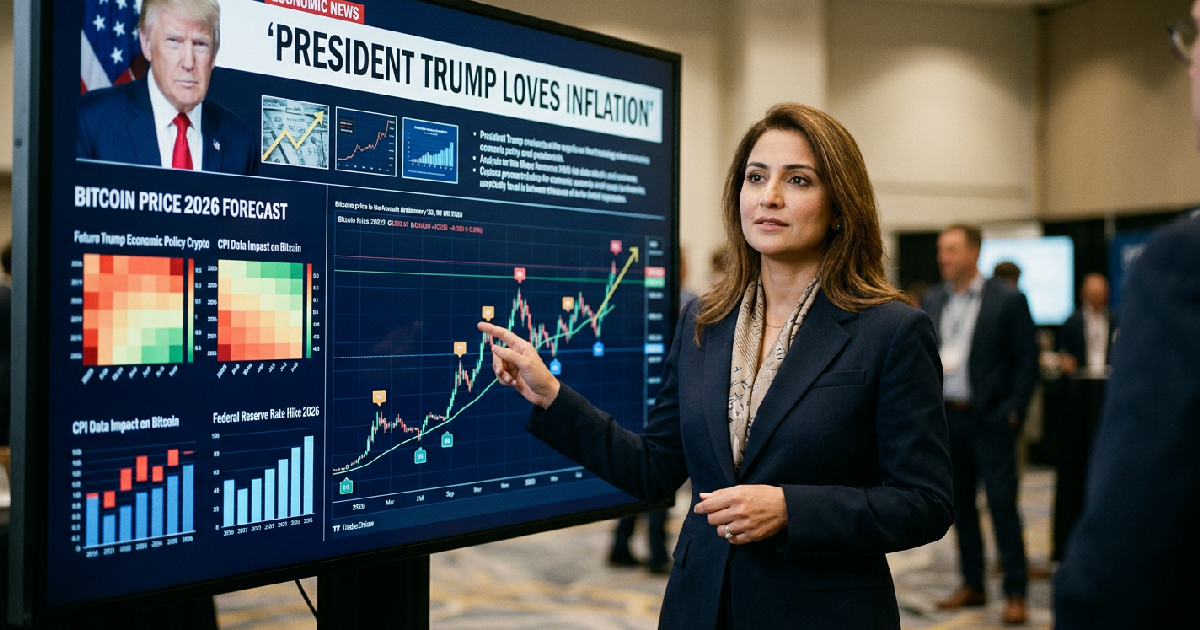

A new analysis from BeInCrypto journalist Kamina Bashir, published on June 11, 2026, explores a hypothetical economic landscape where a future Donald Trump presidency embraces inflationary policies and their subsequent impact on Bitcoin.
The report suggests that such a scenario would create a complex environment for digital assets, forcing investors to weigh the benefits of a “hard money” hedge against the risks of aggressive Federal Reserve interventions.
The core of the projection hinges on the tension between fiscal expansion and price stability. While the research does not state Donald Trump is the sitting president in 2026, it analyzes the “Trump trade” as a speculative framework for the digital asset market.
In this outlook, protectionist tariffs and increased government spending act as primary drivers for a rising Consumer Price Index (CPI), potentially boosting the appeal of decentralized stores of value.
For market participants, this dynamic underscores why Bitcoin signals indicate shifting market structure as the asset matures into a macro-sensitive instrument. The projection notes that while inflationary rhetoric may drive interest in Bitcoin, the reality of “higher for longer” interest rates remains a persistent headwind for speculative appetite and overall market liquidity.
Monetary policy projections and the cryptocurrency hedge
The BeInCrypto report posits that a future administration under Donald Trump might prioritize domestic growth over traditional inflation targets. This shift would likely lead to friction between the executive branch and the Federal Reserve. If the central bank faces political pressure to keep rates low despite rising costs, the narrative of currency debasement could accelerate, pushing institutional capital toward alternative assets.
Recent market data highlights this sensitivity, as seen when the Bitcoin price stabilizes near $77,000 during periods of geopolitical and macroeconomic uncertainty. The analysis suggests that Bitcoin is increasingly viewed through the lens of a “no-lose” scenario: it benefits if inflation runs hot, and it secures its “digital gold” status if the economy slows under the weight of restrictive monetary efforts.
This outlook also places renewed importance on technical indicators. Many professional traders continue to monitor long-term trends, which is why Bitcoin traders care about the 200-day moving average as a definitive gauge of whether the “inflation hedge” thesis is actually translating into sustained price action or merely temporary volatility.
Understanding the second-order effects of CPI volatility
The relationship between CPI data and Bitcoin has evolved since the early 2020s. The digital asset is now tethered to the same liquidity cycles that govern major technology stocks. If projected policies lead to a sudden spike in inflation, the immediate reaction in the 2026 market is often an algorithmic sell-off as traders prepare for a reactive Federal Reserve rate hike.
However, the secondary effect is a flight to quality. Proponents cited in the report argue that Bitcoin’s immutable supply of 21 million coins provides a programmatic defense against discretionary monetary expansion. This ideological alignment keeps interest high, even when short-term price swings suggest a correlation with traditional risk-on assets like the Nasdaq.
What this actually means for the average holder is a market environment defined by “headline risk.” Every statement regarding trade tariffs or Federal Reserve independence now carries the weight of a price-moving event. For the cryptocurrency sector, a pro-inflationary political environment provides a strong fundamental narrative but guarantees a path of extreme price turbulence as the market searches for a new equilibrium.
Critical factors for the 2026 crypto outlook
As the market moves through mid-2026, the intersection of fiscal policy and Bitcoin’s hard-capped supply will dictate the asset’s next major cycle. If a future administration chooses to sacrifice price stability for short-term industrial growth, mainstream financial advisors may finally embrace the “debasement” thesis. This would effectively normalize Bitcoin as a standard component of a diversified portfolio.
The road ahead remains clouded by regulatory hurdles and the inherent volatility of digital finance. The coming months will determine if Bitcoin can successfully decouple from traditional equities or if it will remain a high-beta proxy for global liquidity. For now, the focus remains on the Federal Reserve’s difficult balancing act and the potential for a populist shift in U.S. economic priority.