
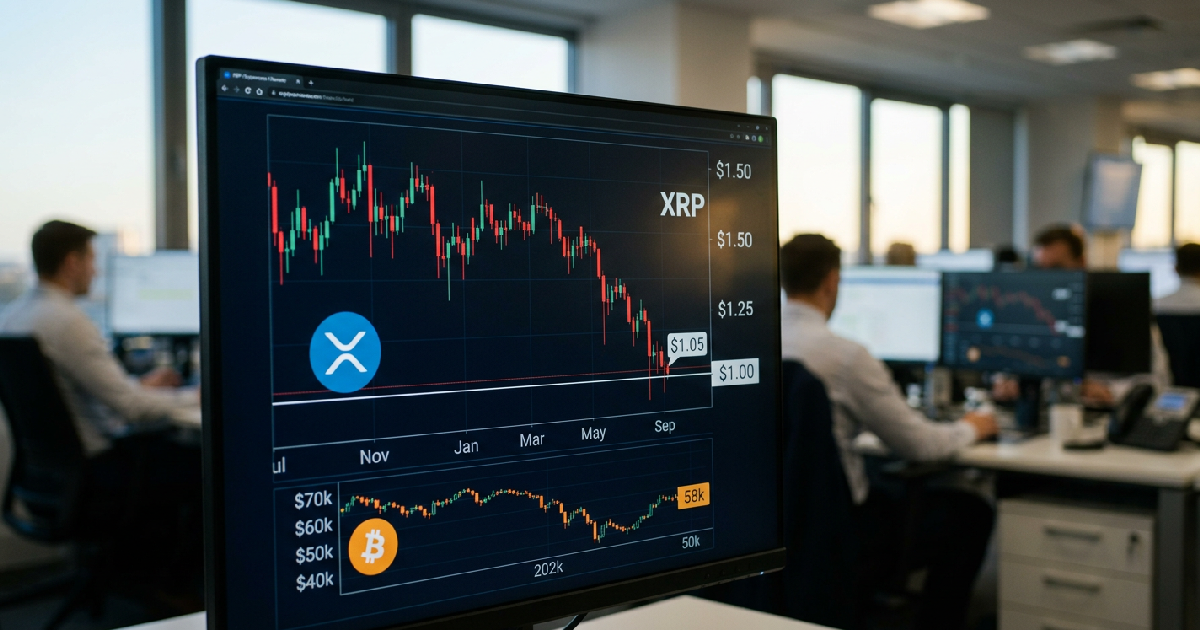

XRP has hit its weakest valuation in months, dropping to a low of $1.05 early Saturday, June 6, 2026. This decline continues a sharp downward trend for the asset, which has struggled to find support after experiencing six consecutive days of losses following its peak of $1.36 on May 30.
As of Sunday, June 7, the token is trading in a volatile range between $1.07 and $1.16, placing it precariously close to the psychological $1.00 threshold.
The recent market turbulence has seen XRP slip behind USDC in market capitalization rankings, now occupying the sixth spot among global cryptocurrencies. While XRP maintains a market capitalization near $72.19 billion, the broader sentiment remains cautious. This shift comes as Bitcoin signals indicate shifting market structure, with the leading cryptocurrency breaking below the $60,000 mark and triggering wider liquidations.
Despite the spot price decline, institutional interest appears to be persisting through specialized investment vehicles. XRP exchange-traded funds (ETFs) recently recorded approximately $4 million in fresh inflows, bringing cumulative inflows closer to $1.5 billion since their launch. However, these figures conflict with the cooling speculative sentiment and lower daily turnover observed on major exchanges over the first week of June.
Macroeconomic factors and historical June volatility
The current pressure on XRP is partly attributed to a broader industry retreat. Over $1 billion in leveraged positions were liquidated across the market as Ethereum recorded a 9.8% drop in a single 24-hour period. Furthermore, seasoned traders often prioritise the 200-day moving average in their analysis, a metric that currently reflects a 45.86% decline for XRP over that period.
Historical data suggests that June is traditionally a difficult month for the asset during midterm election years. In 2014, 2018, and 2022, XRP experienced price drops ranging between 17% and 39%. This seasonal pattern, combined with the Crypto Fear and Greed Index returning to “extreme fear,” has left many investors wary of a potential breach of the $1.00 support level.
Thinning demand has made it difficult for the price to sustain any upward bounces. Earlier in the week on June 4, the token was trading near $1.24, but it failed to maintain that level as selling pressure intensified. Analysts are now closely monitoring whether the current levels can attract enough buy-side volume to prevent a slide toward early 2026 lows.
On-chain metrics and whale distribution patterns
On-chain activity reveals that large-scale holders are active despite the price slump. Over the past week, approximately 60 million XRP were moved or redistributed by whale wallets. While these large holders still control 68.5% of the total circulating supply—the highest concentration since May 2024—the recent movement toward exchanges often indicates a desire to hedge or exit positions.
Supply concerns are further exacerbated by upcoming escrow unlocks from Ripple, which continue to add a steady supply of tokens to the market. This supply overhang requires significant daily liquidity to absorb, which is currently lacking as daily turnover figures decline.
This sits in stark contrast to the bullish environment of November 2024, when XRP surged 18% in a day to cross $1.00 for the first time in three years.
Market outlook and second-order implications
What this actually means for the average investor is a period of heightened uncertainty where technical support levels are being tested more by macro liquidate-on-sight behavior than by fundamental news. While the XRP market dominance path remains a topic of long-term discussion, the immediate priority for bulls is defending $1.05 to avoid a total retracement of the gains made throughout the second quarter of 2026.
And while the $4 million in recent ETF inflows shows that some professional desks are buying the dip, the $5.34 million outflow recorded on June 3 suggests that institutional confidence is not entirely uniform. For now, the market remains in a “wait-and-see” mode, looking toward the next major support zone if the psychological $1.00 barrier fails to hold through the coming week.