
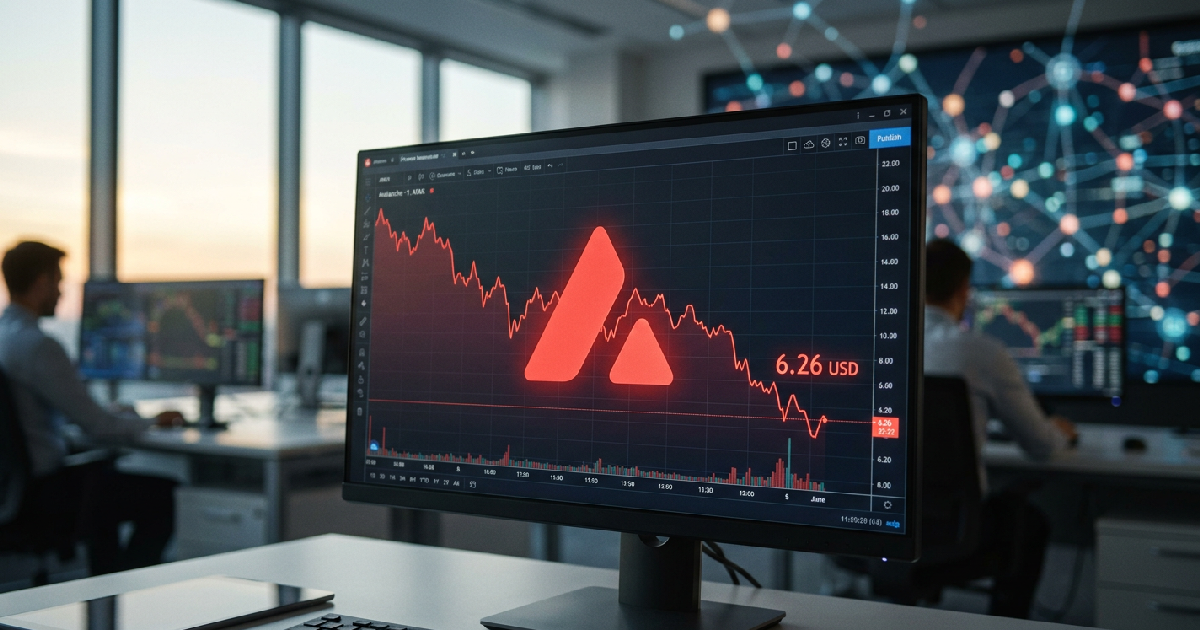

The Avalanche (AVAX) cryptocurrency experienced a sharp 14% price drop within a 24-hour period on June 6, 2026, as the digital asset hit levels not seen since early 2021. The token fell to an intraday low of $6.26, a descent that occurred despite a recorded increase in whale activity on the network. Large holders, though active, failed to provide sufficient price support as selling pressure swept across the broader market.
The move marks a definitive break of the $8.05 monthly support zone, a level that had successfully fended off bear raids since February. By press time, the price had stabilized slightly at $6.70 per data from Investing.com, but it remains trapped below several key Exponential Moving Averages. This technical breakdown coincides with a wider crypto market downturn, where Bitcoin briefly slipped under the $60,000 mark.
Market sentiment has curdled into a state of “Extreme Fear,” with the Crypto Fear & Greed Index plummeting to a reading of 12. As investors instinctively seek safety in high-liquidity assets, high-beta altcoins like Avalanche have faced outsized pressure. Analysts observe that shifting market structures are currently favoring capital preservation over the pursuit of speculative rebounds.
Bearish dominance and the surge in short positions
Derivatives markets show that traders are positioning for further pain. More than 70% of open positions are currently shorts, indicating an overwhelming belief that the downtrend will persist in the coming days. This imbalance creates a self-reinforcing loop of selling pressure, making it difficult for buyers to establish any meaningful momentum.
Conviction appears to be thinning as Open Interest for Avalanche-related positions dropped to approximately $159 million at press time. A decline in Open Interest while prices are falling typically suggests that participants are exiting the market rather than betting on a recovery. While this doesn’t signal an institutional exodus, it does reflect a significant cooling of the enthusiasm seen in previous months.
Some investors are debating which assets can withstand this volatility, and the best altcoin to buy now remains a topic of intense discussion as market cap rankings shift. For now, however, the absence of aggressive accumulation from large-scale entities suggests a “wait-and-see” approach is dominating the institutional sector.
Whale activity fails to check the slide
The most unusual aspect of this 14% slide is the presence of strong whale participation. Ordinarily, on-chain analysts view high whale activity as a precursor to a price floor or a reversal. However, the current selling pressure has been so intense that these large transactions have not translated into a price bounce.
There is currently no clear evidence of panic selling among these whales. Instead, the lack of aggressive accumulation at these multi-year lows suggests that big money is not yet convinced the bottom is in. Trading volumes have remained high, rising 65.8% to $541 million on June 4, confirming that the market remains highly active even as prices deteriorate.
The broader market continues to monitor technical indicators to find where the bleeding might stop. Long-term holders and traders prioritize the 200-day moving average to determine if this move is a transient dip or a long-term regime change. With AVAX down over 67% over the last 12 months, the asset is now firmly in a defensive posture.
Future outlook for the Avalanche network
Immediate recovery for Avalanche depends heavily on the stabilization of the broader market. If Bitcoin continues to test support levels near $59,000, altcoins are likely to remain under pressure. For Avalanche to regain a bullish footing, it must first reclaim the $8.05 level, which has transitioned from a reliable floor into a formidable resistance point.
Institutional demand also remains a missing piece of the puzzle. Beyond a $5.26 million inflow into spot AVAX ETFs in late April, big-ticket buyers have been largely silent. Until fresh capital returns to counteract the high volume of short positions, the technical path of least resistance for Avalanche appears to be sideways or lower.