
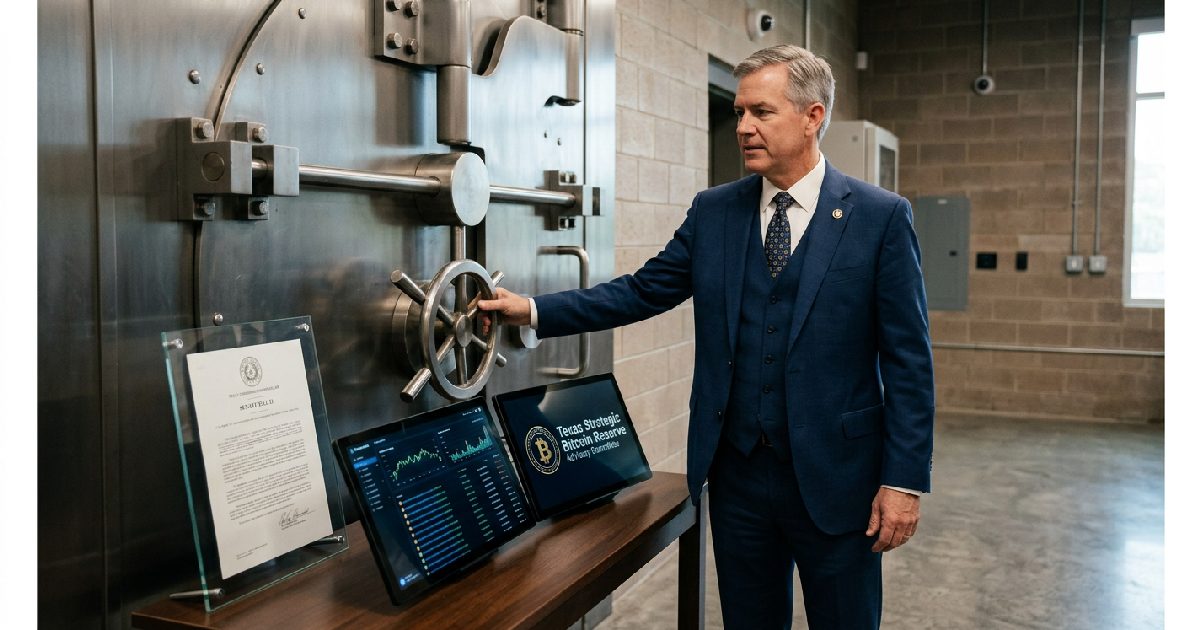

Acting Texas Comptroller Kelly Hancock announced the appointment of the Texas Strategic Bitcoin Reserve Advisory Committee on May 28, 2026, signaling a major shift toward direct state ownership of digital assets. The committee, established under Senate Bill 21 (SB 21), is tasked with overseeing the technical administration and security of the state’s Bitcoin holdings. This move marks the beginning of a transition from exchange-traded fund (ETF) exposure to direct, on-chain custody within the next 60 days.
The state’s strategic reserve is currently managed by the Texas Treasury Safekeeping Trust Company, separate from the general treasury fund. Texas initially moved into the digital asset space when it allocated $5 million into BlackRock’s iShares Bitcoin Trust (IBIT) on November 20, 2025. At the time of that first allocation, the Bitcoin price was trading between $87,000 and $91,000 per token.
Comptroller Hancock emphasized that the office’s responsibility is to manage these assets with “transparency, security and strong financial controls.” By moving away from third-party ETF structures, Texas aims to secure institutional-grade control over its total $10 million appropriation. The shift follows trends where Bitcoin exchange supply has remained at multi-year lows, making direct custody a priority for large-scale holders.
Texas Strategic Bitcoin Reserve Advisory Committee members appointed
The five-member panel consists of Comptroller Hancock and four external experts representing the finance, mining, and legal sectors. Laurie Dotter, chair of the Investment Advisory Board for the Employees Retirement System of Texas, brings over 35 years of governance experience. Her involvement ensures that the reserve’s investment strategies align with the rigorous standards of public fund management.
Jamie McAvity, founder and CEO of Cormint Data Systems, provides a deep understanding of the Bitcoin mining infrastructure. Cormint operates a 130-megawatt facility in Fort Stockton known for its high efficiency. His technical expertise is expected to guide the state in managing the physical and digital requirements of local Bitcoin operations.
Legal oversight is provided by Carla Reyes, a law professor at Southern Methodist University and a member of the Commodity Futures Trading Commission (CFTC) Innovation Advisory Committee. Reyes has previously testified before Congress on blockchain policy. Her role involves navigating the commercial law framework necessary for a state to hold and manage digital commodities safely.
The committee is rounded out by Gary A. Vecchiarelli, CPA, who serves as president and CFO of CleanSpark. Gary A. Vecchiarelli has a background in building institutional-grade trading desks and digital asset governance frameworks. His experience with yield strategies and borrowing facilities will be essential as the state develops its own operational controls for Bitcoin transactions.
Transition from BlackRock IBIT to direct on-chain custody
On May 7, 2026, the Comptroller’s office issued a Request for Proposals (RFP) seeking a qualified firm to provide custody and liquidity services. The selected vendor will be responsible for the secure acquisition and management of the state’s Bitcoin. This move reflects a desire for full ownership, moving beyond the $10 million exposure currently held through the iShares Bitcoin Trust.
The deadline for vendor proposals is set for June 15, 2026, with the transition to direct custody expected to begin by August 2026. This timeline puts Texas ahead of many institutional shifts, even as large banks increase Bitcoin exposure through indirect investments. Texas’s move is distinctive for its commitment to a sovereign custody model.
Under the guidelines of SB 21, any cryptocurrency held in the reserve must meet specific liquidity and stability requirements. Specifically, the asset must maintain an average market capitalization of at least $500 billion over the most recent 12-month period. Currently, Bitcoin is the only digital asset that meets this criterion, effectively making it the sole focus of the state’s current digital stockpile.
Federal Bitcoin reserve hurdles and national outlook
The progress in Austin stands in contrast to the procedural delays facing the federal government’s own reserve plans. President Trump signed an executive order on March 6, 2025, directing the Treasury Department to establish a national Strategic Bitcoin Reserve. This federal reserve was intended to be seeded with 328,372 BTC currently held by the U.S. government through criminal and civil asset seizures.
While the executive order bars the Treasury from selling these holdings, “obscure legal provisions” have slowed the formal codification of the reserve. Patrick Witt, Executive Director of the President’s Council of Advisors for Digital Assets, suggested in May 2026 that a legal breakthrough had been reached. However, a formal announcement regarding the federal stockpile’s activation is still pending.
At the legislative level, the American Reserves Modernization Act continues to advance through Congress. If passed, the act would authorize the Treasury to purchase 200,000 BTC annually for five years. While the first federal open-market purchases aren’t projected until Q4 2026, the Texas Strategic Bitcoin Reserve Advisory Committee is already operational, providing a state-level blueprint for digital asset management.