
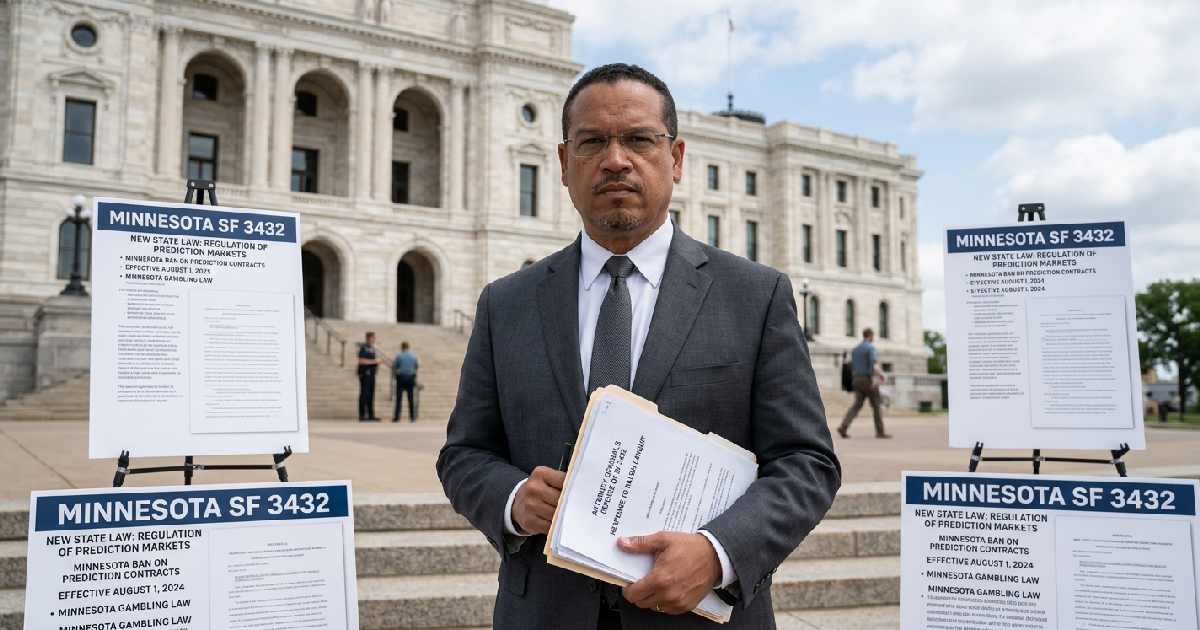

Kalshi, a federally authorized prediction markets platform, has filed a federal lawsuit against the state of Minnesota to block a new law that would effectively ban its operations within the state. The legal challenge, filed in the District of Minnesota, seeks to prevent the enforcement of SF 3432, which Governor Tim Walz signed into law on May 26, 2026. The lawsuit was initiated within 72 hours of the bill’s signing, naming Minnesota Attorney General Keith Ellison, Governor Tim Walz, and Alcohol and Gambling Enforcement Division Director Jon Anglin as defendants.
The conflict centers on a fundamental disagreement over whether prediction markets constitute legitimate financial instruments or illegal gambling. Under the new legislation, slated to take effect on August 1, 2026, Minnesota classifies event contracts tied to sports, elections, and entertainment as gambling. This move has sparked a fierce jurisdictional battle, as Kalshi operates as a Designated Contract Market (DCM) under the federal oversight of the Commodity Futures Trading Commission (CFTC).
The outcome of this case could have ripple effects throughout the broader financial and digital asset sectors. While some traders focus on assessing the impact of market resistance in traditional crypto assets, others view prediction markets as essential hedging tools for real-world political and economic events. Kalshi argues that Minnesota’s law “impermissibly usurps” the exclusive authority granted to the CFTC by the Commodity Exchange Act.
Legal arguments over federal preemption and jurisdictional authority
Kalshi’s primary contention is that the state of Minnesota is attempting to criminalize activity that is entirely lawful under federal regulations. In its lawsuit, the company claims the law would effectively deem it a “felon in Minnesota” for offering products it is authorized to provide at a federal level. This legal push follows a separate challenge from the CFTC itself, which filed a lawsuit against Minnesota on May 20, 2026, after the governor signed an earlier version of the ban.
CFTC Chairman Rostin Behnam has previously expressed concerns regarding state-level interference in derivatives markets. The federal regulator argues that Minnesota is intruding on a space reserved for federal oversight, potentially undermining the stability of commodity derivatives. There are fears that the legislation’s broad scope could unintentionally criminalize traditional risk-management products, such as weather and agricultural hedging tools often used by farmers.
Minnesota lawmakers, however, view the issue through the lens of public safety and consumer protection. State Representative Emma Greenman, a sponsor of the bill, stated that the state must decide what regulations are necessary to “protect our kids” and ensure integrity oversight. Attorney General Keith Ellison was more blunt, asserting that prediction markets are “designed to be addictive” and primarily benefit the “ultra-rich” at the expense of lower-income residents.
Market fragmentation and the future of event contracts
As the first U.S. state to formally ban prediction markets, Minnesota has set a precedent that could lead to a patchwork of conflicting state laws. The legislation is particularly aggressive, targeting not only the platforms but also virtual private networks (VPNs) used by residents to bypass geolocation restrictions. This development occurs as crypto market liquidations and shifting volatility increase the demand for various hedging mechanisms across the United States.
The political stakes are also rising, with high-profile figures taking interests in the sector. Donald Trump Jr. currently serves as an adviser to Kalshi and is an investor in Polymarket, another platform affected by the state’s restrictive stance. The intersection of political sentiment and financial regulation makes the Minnesota case a bellwether for how other states might handle “event contracts” in the lead-up to the 2026 election cycle.
Legislative carve-outs for agriculture and insurance
Before SF 3432 was finalized, Minnesota lawmakers introduced several revisions to address concerns from the local agricultural sector. The law now includes carve-outs for traditional commodities, securities trading, and insurance contracts intended to cover actual harm or loss. After intense lobbying from agricultural interests, the bill was also adjusted to permit weather trading, a vital tool for the state’s farming economy.
Despite these concessions, the core of the law remains a total ban on the specific “event contracts” that form the heart of Kalshi’s business model. Federal courts must now weigh the state’s traditional “police power” to regulate gambling against the federal government’s authority over interstate commerce and financial markets. If the court grants the injunctive relief Kalshi seeks, it would temporarily halt the ban before the August deadline, allowing the platform to continue operating while the broader legal merits are debated.