
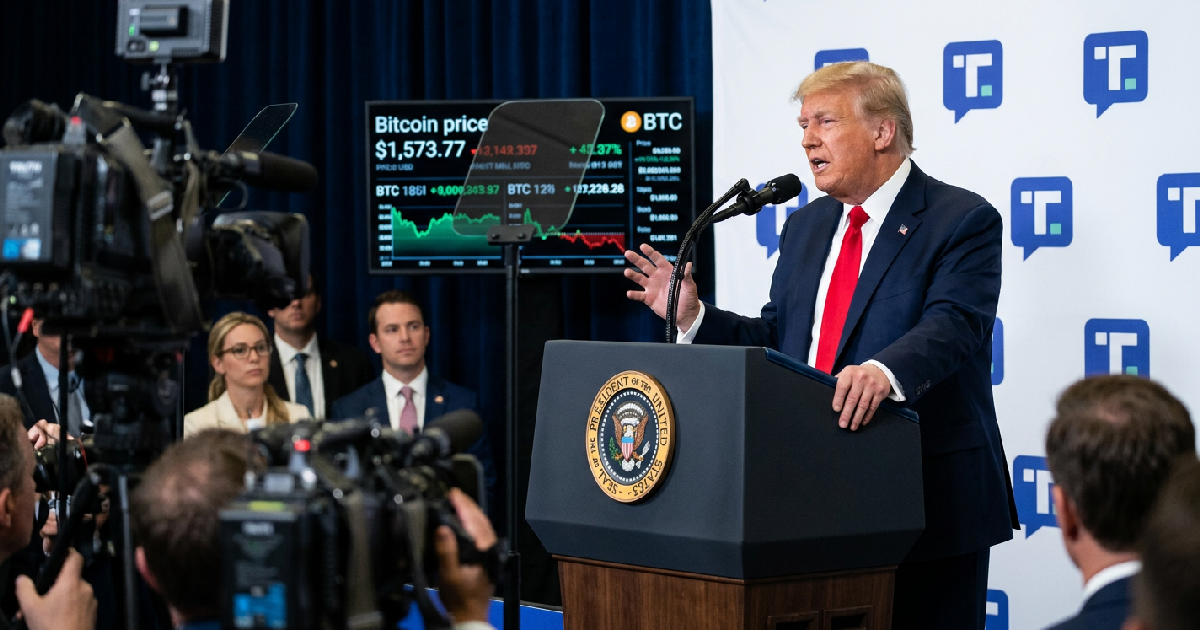

Former U.S. President Donald Trump issued a strong defense of prediction markets and Bitcoin on Tuesday, May 26, 2026, using his Truth Social platform to praise Commodity Futures Trading Commission (CFTC) Chairman Michael Selig. Donald Trump argued that the agency must maintain exclusive federal authority over these markets to ensure the United States remains the “Crypto Capital of the World.” The statement comes as several state officials move to restrict or ban decentralized and digital asset trading platforms within their borders.
The former president specifically criticized a group of state leaders, including New Jersey’s former Governor Chris Christie, New York Attorney General Letitia James, Minnesota Governor Tim Walz, and Illinois Governor JB Pritzker. Donald Trump labeled the group “SCUM” for attempting to set their own rules for the industry. He warned that if the U.S. does not protect this “major industry,” other countries will diligently work to replace the nation as the global hub for digital assets.
The endorsement of Chairman Michael Selig follows a significant shift at the CFTC. On February 4, 2026, Chairman Michael Selig withdrew a Biden-era proposal that would have prohibited sports and political event contracts. He has since pledged to “work tirelessly” to facilitate innovation and has even filed an amicus brief with the U.S. Court of Appeals for the Ninth Circuit to defend the agency’s exclusive jurisdiction against state-level interference.
Rising demand and market resistance for Bitcoin
Donald Trump’s public support for the sector coincides with increased volatility and underlying Bitcoin price analysis showing heavy resistance at higher levels. On May 23, 2026, Bitcoin experienced a sharp drop of nearly 10%, falling to $74,027 following a $766 million liquidation event. Analysts at Bitfinex have noted that $79,000 currently serves as a heavy breakeven resistance point that buyers are struggling to overcome.
Despite these price fluctuations, the prediction market sector is seeing rapid expansion. Estimates suggest that user counts for these platforms have quadrupled in roughly two years. This surge in interest has made the regulatory “rules of the road” a focal point for the 2026 political cycle. Donald Trump stated that while some people disagree on the merits of prediction markets, the fact that other countries are adopting them means the U.S. cannot afford to be “left out in the cold.”
The heightened activity in these markets was underscored by a notable incident on March 23. Reports indicate that a trader placed approximately $500 million in oil and equities futures trades just minutes before President Donald Trump posted about ceasefire talks on Truth Social. This kind of high-stakes trading has intensified the debate over whether federal oversight is enough to prevent market manipulation, especially as crypto liquidations rise alongside broader macro warning signs in the economy.
Legal battles over state versus federal jurisdiction
The conflict between federal regulators and state officials has reached a boiling point in 2026. New York Attorney General Letitia James has filed lawsuits against major exchanges including Coinbase and Gemini, while Illinois regulators have issued cease-and-desist orders. A coalition of 37 states and Washington, D.C. has backed arguments that these platforms violate state-level anti-gaming and consumer protection laws.
Chairman Michael Selig has taken a combative stance, stating he will no longer “sit idly by” while state governments undermine the CFTC’s authority. He emphasized a zero-tolerance policy for fraud and manipulation but insisted that the Commodity Exchange Act provides the agency with “very broad, exclusive jurisdiction.” Prediction market operator Kalshi has already faced roughly 20 lawsuits from various states, prompting the company to hire Donald Trump Jr. as a strategic adviser.
The Trump family’s ties to the industry extend beyond advice. Donald Trump Jr. also joined the advisory board of Polymarket, a platform that operates on the Polygon blockchain and settles contracts in USDC. Truth Social itself is entering the fray, partnering with Crypto.com to provide prediction markets directly through the social media platform. These connections suggest that the future of prediction markets is becoming deeply entwined with national political strategies and shifting investor sentiment across major exchanges.
Future outlook for American crypto leadership
Donald Trump’s recent statements signal a clear intent to prioritize federal deregulation if he returns to leadership. By framing prediction markets and Bitcoin as essential to national security and economic dominance, he is positioning the CFTC as a shield against state regulators. Chairman Michael Selig has mirrored this sentiment, telling those who challenge the agency’s authority, “we will see you in court.”
Whether this federalist approach can withstand the onslaught of state-level lawsuits remains to be seen. However, for now, the alliance between the former president and the CFTC leadership represents a significant barrier to the fragmented regulatory environment that state officials are trying to create. As user adoption continues to climb, the pressure to establish a “Gold Standard” for federal rules will only intensify.