
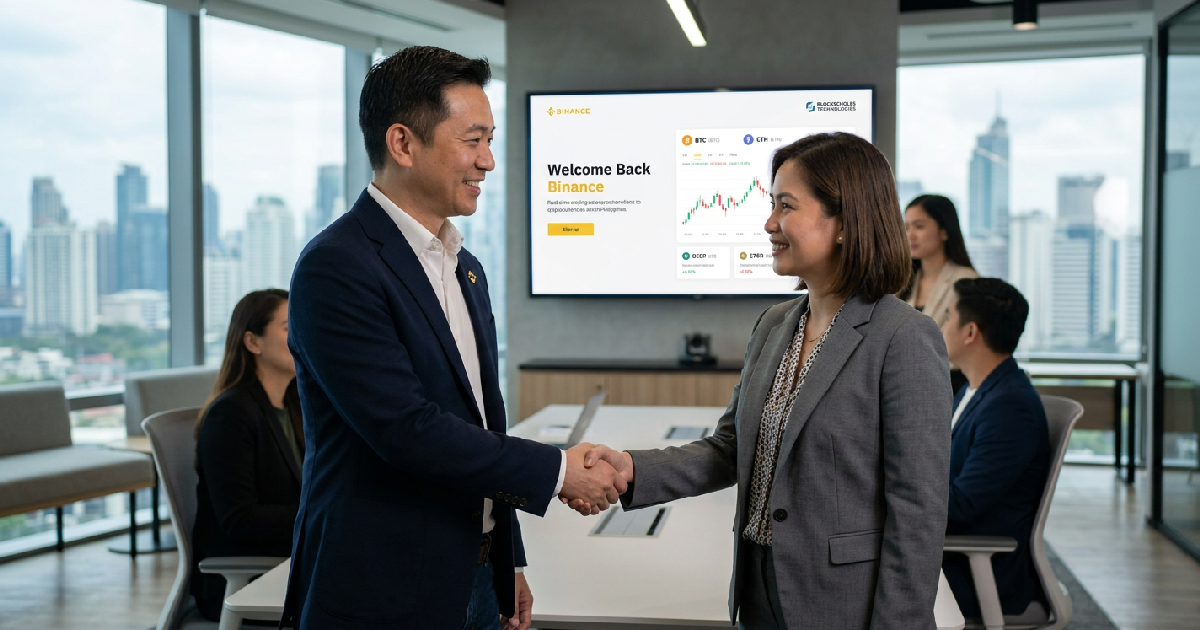

Binance announced on Tuesday, May 26, 2026, that it has entered a partnership with local fintech firm BlockScholes Technologies to facilitate a regulated return to the Philippine market. This move represents the exchange’s first formal attempt to restore its business presence in the country through local partnerships and direct regulatory engagement. Under the terms of the agreement, Binance will provide technology, security, operations, and compliance expertise, while BlockScholes Technologies serves as the approved local brokerage operator and intermediary.
The re-entry effort utilizes the Philippine Securities and Exchange Commission (SEC) Strategic Sandbox, known as StratBox, which was established under SEC Memorandum Circular No. 9, series of 2024. BlockScholes Technologies received in-principle approval to enter this sandbox framework in November 2025. This arrangement allows Binance to offer its services indirectly to one of the world’s most active crypto markets, even as Bitcoin exchange supply remains at multi-year lows following shifts in global sentiment.
Regulatory friction between the exchange and Manila has been intense for several years. The Philippine SEC first issued public warnings against the exchange in November 2023, citing it for offering unregistered securities. In March 2024, the National Telecommunications Commission (NTC) began blocking access to the exchange’s webpages. By February 2026, the Binance app had reportedly vanished from the Google Play Store in the Philippines, complicating access for millions of users who made the country ninth in the 2025 Global Crypto Adoption Index.
Understanding the SEC StratBox framework and compliance
The StratBox framework allows approved firms like BlockScholes Technologies to test financial products in a live but controlled environment. During this period, the regulator can adjust licensing or registration requirements. The sandbox phase for this partnership is scheduled to begin in the second half of 2026. Binance officials expect the evaluation process to last at least two years, aligning with the standard 24-month testing period dictated by the SEC.
By using a local partner, the exchange navigates the ongoing moratorium on new virtual asset service provider licenses maintained by the Bangko Sentral ng Pilipinas (BSP). This structure is designed to bring digital asset services into a compliant framework while satisfying transparency and consumer protection standards. This is particularly relevant as updates to BNB-related filings in other jurisdictions continue to draw institutional interest to the exchange’s ecosystem.
Navigating local political hurdles and industry warnings
The partnership surfaces amid lingering local controversies. BlockScholes Technologies has been the subject of reports linking its shareholders to figures involved in a flood control corruption scandal. In that investigation, crypto wallets were allegedly used to move illicit funds. Some observers have raised concerns about potential political influence behind the regulatory approval process, though the SEC has continued its broader crackdown on other offshore platforms.
Since August 2025, Philippine regulators have warned investors against 10 other major exchanges, including OKX, Bybit, Kucoin, and Kraken. More recently, on April 21, 2026, the SEC added dYdX, Aevo, and five other platforms to its warning list. This suggests that the sandbox route is currently the only viable path for large-scale international players to operate without being blocked by the NTC or facing local enforcement actions under the Crypto Asset Service Provider (CASP) rules.
Operational roadmap for the 2026 sandbox phase
The roadmap for the partnership outlines clear responsibilities to ensure compliance with the Securities Regulation Code. Under the StratBox term, BlockScholes Technologies retains the primary responsibility for local operations, while Binance remains a technical and operational service provider. Key components of the rollout include:
- Compliance Integration: Binance will share its global experience in AML/CFT protocols to meet Philippine standards.
- Local Brokerage: BlockScholes Technologies will act as the customer-facing entity for all Philippine-based traders.
- Regulatory Oversight: The SEC will conduct periodic reviews, with the power to shorten or extend the sandbox phase after the first year.
- Service Restoration: The companies aim to bring specific digital asset products back to the local market in a phased approach.
The success of this trial will be a bellwether for the region. As other nations refine their digital asset policies—similar to how Russia lawmakers have moved toward legalizing P2P trade—the Philippines is testing whether a sandbox can balance innovation with strict enforcement. If BlockScholes Technologies completes its testing period successfully, a full license could follow as early as late 2028.
Future outlook for the Philippine crypto market
The 24-month duration of the sandbox means that a full return to the “pre-ban” status of 2023 is still some years away. Users should expect a gradual release of features rather than an immediate full restoration of the app’s previous capabilities. The SEC’s willingness to entertain this partnership suggests a potential shift toward bringing major players under a localized, domestic-led model rather than allowing them to serve the market from abroad.
For now, the focus remains on the second half of 2026 when the live testing officially begins. Market participants are watching to see if this partnership provides a blueprint for other restricted exchanges to return through similar fintech intermediaries. With the BSP’s moratorium on new licenses still in place, the SEC’s StratBox has become the most critical gateway for the future of the Philippine digital asset industry.